


Can You Wallpaper A Bathroom?
Yes, you can wallpaper a bathroom, and most modern wallpaper formats handle bathroom conditions if you choose the right material. Powder rooms and dry bathrooms accept standard non-woven wallpaper without trouble. Family bathrooms with showers and tubs need vinyl-on-non-woven or a moisture-rated reissue, and for a humid bathroom House Digest's top pick is solid vinyl. The format has become one of the leading 2026 bathroom upgrades, with major heritage brands now selling chinoiserie murals and Arts and Crafts patterns specifically in vinyl-on-non-woven for wet rooms. Most weekends, a careful DIYer can wallpaper a powder room with two rolls of $18-per-roll wallpaper and a quart of paste.

This guide covers whether bathroom wallpaper is a good idea, what kinds of wallpaper work in a bathroom, whether wallpaper will stay up under humidity, the pros and cons of bathroom wallpaper, how to install it properly, the common mistakes to avoid, whether you can use peel and stick in a bathroom, how to maintain bathroom wallpaper, and the popular bathroom wallpaper styles for 2026.
Is it a good idea to wallpaper a bathroom?
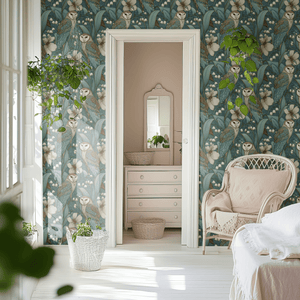
Yes for powder rooms and dry bathrooms. A powder room is just a small bathroom with no shower, so the air in there stays close to what you'd find in a dry room, and standard non-woven handles it well. We'd go further and call it the best room in the house for pattern. A big floral that would shout across a living room wall feels cozy, even atmospheric, when you can nearly touch both walls at once. Higher-end homes treat it as a default upgrade now.
The family bathroom is a yes too, on the right format. In a house where three people shower one after another before school, and somebody flicks razor water at the wall on the way out, you want vinyl-on-non-woven. Its vinyl face wipes clean. It also shrugs off the steam and the splash (the sort of moisture damage that would wreck paper-only wallpaper), so all that cleaning afterward doesn't wear it down.
Inside the shower stall, the answer is generally no. Where water hits the wall directly, even the best vinyl format is a poor choice, and we'd tile those wet-zone walls every time. That still leaves more than you might expect. The dry walls are all fair game. So is the space around the vanity, and the wall behind the toilet. Got tile wainscoting? Carry the paper up above it.
What kind of wallpaper can you use in a bathroom?
Vinyl-on-non-woven is the leading wet-bathroom format. If the room has a shower, start there. A vinyl face is bonded to a non-woven backing, and each layer pulls its own weight. The face takes the moisture and the wipe-downs. Underneath, the backing pastes onto the wall just like standard non-woven, which is why the install stays easy. Most heritage brands now sell their most popular patterns this way for bathroom use.
Standard non-woven is fine for powder rooms and dry bathrooms. It's the modern residential standard for dry rooms anyway, and a bathroom without much moisture won't trouble it. The What Is Non-Woven Wallpaper guide goes into the format in detail.
Peel and stick has a place, just a narrower one. It suits renters and short-term projects in powder rooms. Print quality has improved sharply since 2020, but on long-term performance in moist rooms it still lags behind traditional vinyl-on-non-woven. A family bathroom with a shower? Leave peel and stick out of that one.
There are two materials we'd keep out of a bathroom altogether. Traditional paper wallpaper is one. Paper soaks up moisture and expands, and over time it pulls away from the wall, so it belongs in dry rooms only. Grasscloth is the other. Its natural fibers stain and warp once they get damp.
Will wallpaper stay up in a bathroom, especially with humidity?
Yes if you pick the right format and install it correctly. The right format is vinyl-on-non-woven on a strong wallpaper paste, and that part takes about a minute to decide. Installing it correctly takes longer. You need a properly primed wall, plus an exhaust fan that genuinely pulls the steam out of the room. Get both and the paper holds for ten to fifteen years, its vinyl face taking the steam and splash that would ruin standard wallpaper.
If we had to rank them, the fan wins. It matters more than the format does. After a long hot shower the mirror's fogged over and the tiles are beaded with water, and it's the fan, left running for fifteen to twenty minutes afterward, that brings the humidity back down to a level every wall finish in the room can live with. Without one, even the best vinyl wallpaper has a hard time. No fan? Fit one before the first strip goes up.
Primer is the other half. It's boring, and it's worth it. A coat of wallpaper-specific primer goes on before anything else, so the paste gets an even surface to grab and moisture can't get through to the drywall behind it. Clean-looking old paint makes skipping it tempting (we get it). Do that in a humid bathroom, though, and within months you'll be pressing a lifting edge back down with your thumb.
Is wallpaper out of style in 2026?
No, the opposite. Wallpaper has been back in fashion for most of the 2020s, and a bathroom is about the easiest room to try it in, since there's so little wall to cover. Pick up a major design magazine and look at its bathroom remodel stories. Roughly half of them have wallpaper.
The change was mostly one of mood. People turned away from cool minimalism and toward maximalist rooms, and the format came back into the mainstream with them. Heritage wallpaper brands noticed. They now sell their most popular patterns in vinyl-on-non-woven, aimed squarely at bathrooms and kitchens. Powder rooms in particular have become one of the leading places for bold pattern, and we think that's the right instinct, because in a space that small a dramatic statement comes across as confident rather than overwhelming.
What are the pros and cons of using wallpaper in a bathroom?
Bathroom wallpaper transforms what is typically the least-decorated room in the house into a visual highlight. A can of paint gives you a color. A pattern gives you color with some decorative weight behind it, and a personality paint just can't match. Powder rooms get the most from it, because guests only pass through briefly, and in a visit that short a bold pattern comes across as theatrical. There's a practical upside too. Over the long run, vinyl-on-non-woven bathroom wallpaper holds up better than paint, since the vinyl face stands up to the wipe-downs a bathroom needs.
The downsides are real, though. Per square foot, bathroom wallpaper costs more than paint, in the material and in the hours it takes to hang. Prep is fussier as well. There's a primer coat to get on first, and the seams want patience to line up. You also can't cheat on the format, because standard paper wallpaper fails in any wet bathroom, so it's vinyl-on-non-woven or no project at all. And it's harder to change than paint. Get tired of the pattern a few years in and replacing it is a much bigger job than picking up a roller.
How do you properly install wallpaper in a bathroom to prevent issues?
Start with a working exhaust fan. Yes, the fan again. It keeps coming up on this page because no wallpaper lasts in a wet bathroom without ventilation, so it should run while you shower and for fifteen to twenty minutes after. If the room doesn't have one, add it before you open a single roll.
Next, fix the wall itself, before any primer goes near it. Run your palm across the surface and you'll feel what needs work. Fill cracks with joint compound and sand the whole wall smooth; paint that's peeling gets scraped away. Old wallpaper comes off too, all of it, before the new goes up.
Then prime, with a wallpaper-specific primer like Zinsser Shieldz or a similar product. This coat is what gives the paste an even surface to bond to, and it seals the drywall against moisture at the same time. Let it dry fully. Not mostly dry. Fully, before you hang a single strip.
Hanging depends on the format, and in a bathroom that usually means vinyl-on-non-woven, which is paste-the-wall like standard non-woven. The paste is rolled onto the wall. Each strip goes up dry and gets pressed into it while it's still wet. The How to Hang Wallpaper guide covers the install in detail.
Caulk is the last step, and we wouldn't skip it. Lift typically starts at the edges where paper meets a wet surface, so run a bead of clear waterproof caulk along the tile line. The tub edge gets one too, and so do the sink and the toilet. Match it to the other caulk lines in the room and it keeps moisture out of those edges.
What are common mistakes to avoid when wallpapering a bathroom?
Choosing the wrong format is the most common mistake. Hang standard paper wallpaper in a wet bathroom and it will fail. If there's a shower or a tub in the room, or just a lot of steam, it gets vinyl-on-non-woven. Always. Standard non-woven stays in powder rooms and dry bathrooms.
Second is skipping the primer. It's tempting when the existing paint looks fine. Bathroom walls still need a primer coat before wallpaper goes on, though, because without one the edges can lift within months under bathroom humidity.
Third is ignoring ventilation. A bathroom without a working exhaust fan isn't a good wallpaper candidate, since steam builds up and damages even the best vinyl wallpaper over time. Add or replace the exhaust fan first if you need to.
Then come the edges. Not caulking them where they meet wet surfaces is mistake number four. The seams where wallpaper meets tile, tub, sink or shower are the failure points. One bead of clear waterproof caulk seals those edges and adds years to the install life.
The fifth mistake? Running wallpaper across the shower wall itself. Direct shower spray damages wallpaper of any format, so keep it on the bathroom's dry walls and let tile handle the wet zone, just as we said near the top.
Can you use peel and stick wallpaper in a bathroom?
Yes for powder rooms and rental bathrooms. It does best in a bathroom that stays dry. Renters get the obvious perk, since there's no paste, and on moving day it comes off the wall in long, clean pulls. Prints have gotten a lot better since 2020 as well. For a bathroom you'll redo in a few years anyway, we'd call it a fair choice, not a compromise.
Add a daily shower and we'd think twice. On a low-moisture wall the adhesive holds up reasonably well; heavy steam is where it can let go. Wiping it down doesn't help. Every pass of the cloth loosens the bond a little, and faster than it would on vinyl-on-non-woven. Three to seven years is about what you'll get before the adhesive starts to fail. If the paper is meant to stay put in a wet bathroom, traditional paste-the-wall vinyl will serve you better over the long run.
Whichever bathroom you've got, test a patch before you do the whole room. Peel and stick grips best on smooth paint with a flat or eggshell finish. Gloss is trouble, because a glossy wall can keep the adhesive from taking hold. Wipe the wall down and stick one small piece up in a corner nobody looks at. Then come back later and check whether its edges are still lying flat.
How do you maintain wallpaper in a bathroom?
Wipe the wallpaper gently with a damp cloth every few weeks to remove soap film, hair product residue, and general bathroom dust. Honestly, that's most of the job. When a splash of toothpaste or a smudge of something won't lift, stir a little dish soap into water and use that mild solution, nothing stronger. Abrasive cleaners can stay under the sink. So can the scrub sponges, and anything with bleach in it is out entirely. The How to Clean Wallpaper guide covers cleaning in full.
Hang on to the fan habit from the install. It should run through the whole shower and for the same fifteen to twenty minutes afterward, because humidity is what slowly works on the paste behind the paper. You won't see it happening. A bathroom with a weak fan, or none, simply ends up with paper that lifts sooner than it would in a well-ventilated room.
Every few months, run a fingertip along the seams and edges. Start beside the shower, where they deserve the closest look. After that, check the ones by the tub and the sink. Any seam that's begun to separate gets a bead of caulk, and caught early it's a small repair. Let it go and you could end up replacing a full panel.
And try not to steam the paper directly. A hot shower with the door shut makes enough steam to stress wallpaper paste, so crack the door open or flip the fan on. With that kind of reasonable care, vinyl-on-non-woven bathroom wallpaper lasts ten to fifteen years.
What are some popular styles or design ideas for bathroom wallpaper?
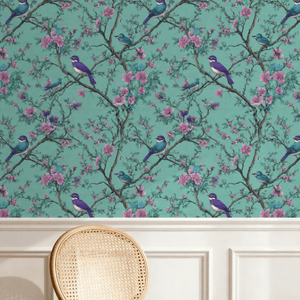
Chinoiserie murals lead the luxury bathroom market. Our favorite is the traditional bird-and-flower pattern, with branches climbing the wall and small birds perched along them. Blue-and-white toile and jade-and-cream work just as well, in a powder room or a family bathroom, as long as they're in vinyl-on-non-woven.
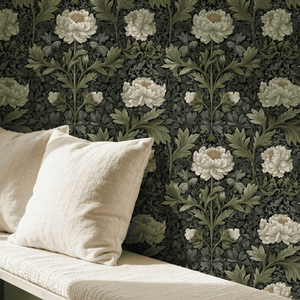
Heritage William Morris patterns work in bathrooms too, in moisture-rated formats. Strawberry Thief is the one we'd point to first. Up close it's thrushes with strawberries in their beaks among the leaves, and it scales well to a small bathroom, as do Willow Bough and similar designs. In a traditional or country-style bathroom they sit very comfortably.
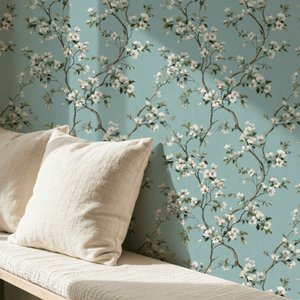
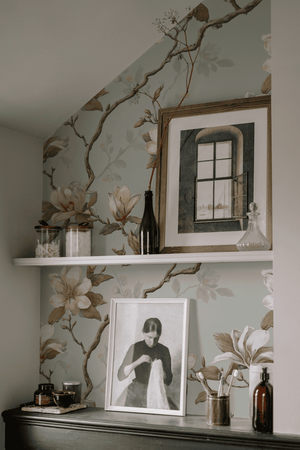
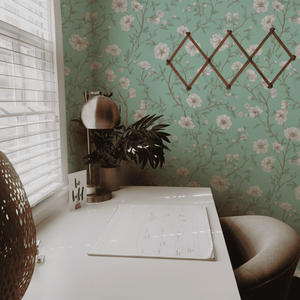
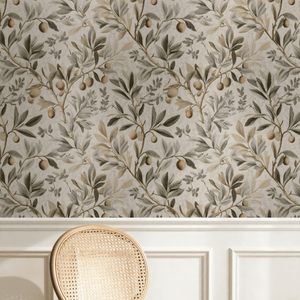
If your bathroom leans modern, look at botanical and tropical patterns. Large-scale leaves are the boldest of the bunch. Flowering vines and watercolor florals work in the same places: a powder room, or a family bathroom if the paper is vinyl-on-non-woven. Our watercolor wallpaper collection has options that suit bathrooms.
Geometric and trellis patterns work in modern bathrooms, and in powder rooms with strong architectural detail. Love marble but not the price tag? Marbled and stone-effect wallpapers give you the look at a fraction of the cost.
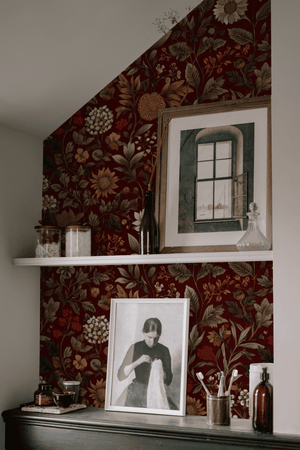
In a family bathroom the kids use, sea life and koi fish patterns earn their keep. The subject is playful, and that suits a room in daily use. Cottagecore florals belong somewhere else, in a small powder room in a country or cottage-style home. Whichever way you go, let the room decide: the decor already in it, and how much moisture it sees on a normal morning.
Bathroom wallpaper questions
Is it a good idea to wallpaper a bathroom?
Yes for powder rooms (no shower) with standard non-woven wallpaper. Family bathrooms work too on vinyl-on-non-woven, which lasts ten to fifteen years when it's hung properly, though we'd still leave the shower wall itself to tile.
How long does bathroom wallpaper last?
Vinyl-on-non-woven wallpaper installed properly in a well-ventilated bathroom lasts ten to fifteen years. Peel and stick is the short-timer at three to seven. Standard non-woven in a dry powder room, looked after properly, can go as long as the wet-rated kind.
What's the difference between bathroom wallpaper and regular wallpaper?
The base material is the same; the face material differs. On bathroom wallpaper that face is vinyl, which resists moisture and gentle cleaning, while regular non-woven is printed on a paper or fiber face that can't handle moisture, so a powder room can take it and a room with a shower can't.
Where can I buy bathroom wallpaper online?
The William Morris Designs collection at williammorriswallpaper.co carries the full Morris heritage range plus contemporary chinoiserie, botanical, watercolor, and geometric wallpapers in formats suited to bathroom installation. Full disclosure: it's our shop.


