


Traditional Japanese Patterns
Japanese patterns, called wagara, are the traditional repeating designs of Japanese dress and craft, and most of them are small geometric grids named for something in nature, like a hemp leaf or a tortoise's shell. Wa means "Japanese-style" and gara means "pattern." Many took their Japanese form at the Heian court (794 to 1185), with roots that run further back, often to China. The geometric ones are tessellations, one small unit repeated edge to edge until it covers a whole kimono. And almost every one carries a wish. Long life, in the tortoiseshell. Straight, healthy growth, in the hemp leaf (which is why it went onto children's clothes).

Japan, Stencil with Hemp-Leaf Pattern, early 19th century. Public domain, via The Metropolitan Museum of Art.
What are traditional Japanese patterns called?
They're called wagara, and the oldest group, the patterns of the imperial court, has a name of its own: yusoku monyo. Those court designs came over from the continent with the waves of Tang Chinese influence in the eighth and ninth centuries, and were slowly reworked into something Japanese. At the Heian court a pattern was never only decoration. It signaled your family's standing and your court rank, on clothing and on furniture alike.
Stencils carried them much further. Late Muromachi paintings already show stencil workshops in business, with Shirako in Ise among the places cutting them. A katagami stencil is mulberry paper treated with persimmon tannin, which makes it waterproof. The dyer lays it on the cloth, pushes rice paste through the cut-outs, then dyes. Wash the paste off and the pattern sits there in bare cloth (early Edo silks were often white dots on blue).
The tiny stencil repeats were such a hit in the Tokugawa capital that the cloth took the city's name. Edo komon, people called it.
What is the asanoha pattern?
Asanoha is the hemp-leaf pattern, six identical diamonds set around a central point to form a six-pointed star, repeated so the stars lock together across the cloth. The geometry was used all over ancient Asia. Only in Japan did anyone look at it and see hemp.
That reading makes sense. Hemp was grown widely in Japan and turned into textiles, as the Met notes beside its early-19th-century hemp-leaf stencil (the one shown above). It also grows straight. So the pattern went onto children's garments, a hope worked into the clothes that the child would grow up healthy and straight.
Its early career was religious. On Buddhist statues from the Heian through the Muromachi periods (roughly 794 to 1573), asanoha turns up on the figures' clothing. Then Edo gave it a star. The kabuki actor Iwai Hanshiro V (1776-1847), adored for his young female roles, promoted the pattern, and it became one of the period's favorites.
Dyers used it. So did weavers, and papermakers and woodworkers too. We'd call it the most adaptable design in the whole set: simple enough to cut cleanly in a stencil, strong enough to hold up at almost any size.
What does shippo mean?
Shippo means "seven treasures," and the shippo pattern is a chain of overlapping circles, each one cut by its neighbors into four pointed spindles around a small star. The treasures are the Buddhist seven, a list that starts with gold and silver and ends with crystal.
Why name a circle pattern after treasure? Nobody's sure. The same word is Japan's name for cloisonne enamel, shippoyaki, and some scholars think the design got its name because cloisonne workers used it so much. Others say there's no proof of that at all. We rather like that the argument is still open.
Its record in Japan goes back a long way. The earliest appearance is on fabrics preserved in the Shosoin repository in Nara (756). Heian painters of Buddhist paintings laid it out in cut gold, a technique called kirikane. By the Edo period it had moved onto porcelain and lacquer, often mixed with other designs, and ukiyo-e prints show women wearing it on kimono.
The meaning is easier to read than the name. The circles link without a break, and the Met describes the pattern on an early-17th-century lacquered incense box as a chainlike motif that "symbolizes prosperity and continuation." Wealth that keeps going, then.
What is sayagata?
Sayagata is a continuous fret made of interlocking manji, the Buddhist sign of good fortune, joined so the arm of one runs straight into the next. The name is usually explained as a contraction of sa-ayagata, a "gossamer figured-cloth pattern," after the cloth it most often appeared on.
The manji itself is ancient. It's the same shape English calls the swastika. It's thought to have reached China from India with Buddhism, becoming a written character there. In Japan it first shows up as an inscription on the leg of the Yakushi triad at Yakushiji temple in Nara, dated 697. From the Heian period on, it marked the crests of temples and families, and when its legs were drawn out long they meant good fortune without end. That's the sense sayagata carries.
As a pattern, sayagata came much later, on imported cloth. It didn't reach Japan until the Tensho era (1573-92), when Chinese fabrics bearing it arrived in large quantities, and in China that was the Ming dynasty (1368 to 1644). One older account traces the motif further back, perhaps to ancient Indian architecture. The Met keeps it simpler: its stencil's continuous fret pattern came from China and became extremely common in Japanese dress during the Edo period.

Japan, Stencil with Continuous Fret Pattern (sayagata), 19th century. Public domain, via The Metropolitan Museum of Art.
Mostly it worked as a ground. Many silk kosode robes of the 17th to 19th centuries were made of rinzu, a light figured satin typically woven with tiny flowers on a sayagata background, and early Edo cargo lists show large amounts of rinzu coming in from China. Dyers and embroiderers then went to work on top. Chrysanthemums and plum blossoms were common partners. It ran around the borders of rugs and tablecloths, too.
What is the kikko pattern?
Kikko is the tortoiseshell pattern, a grid of hexagons modeled on the plates of a tortoise's shell, and in Japan it stands for long life. On a family crest you'll see a single hexagon. Linked into a repeat it becomes kikko-tsunagi, the form you'll meet far more often.
It began as a Chinese motif and turned Japanese at the Heian court, loved there for its refined, dignified look as much as for the luck. Court dress used it heavily. Later it moved onto warriors' kimono and armor, which seems fitting for a shell. Buddhist art took it up as well, and so did lacquerers and metalworkers.
The variant with the best backstory is bishamon kikko. It's named after Bishamonten, one of the Four Guardian gods, who was usually shown in armor patterned with three hexagons joined into a Y. The Met's little silk fragment below goes gentler and drops a chrysanthemum into each cell.

Japan, Textile fragment with pattern of chrysanthemums on hexagonal lattice (Kikkō), 18th to 19th century. Public domain, via The Metropolitan Museum of Art.
If the word sounds familiar, the soy sauce maker Kikkoman puts a kikko hexagon in its logo, with the character for 10,000. Take the flowers out and you're left with a plain honeycomb, a staple of geometric wallpaper that we suspect most people never connect to Japan.
What are the other Japanese pattern names?
After the big four, the Japanese pattern names you'll hear most are seigaiha and ichimatsu, and the rest are mainly court and samurai patterns.
| Name | In English | Associated with |
|---|---|---|
| Asanoha | Hemp leaf | Healthy, straight growth |
| Shippo | Seven treasures | Prosperity and continuation |
| Sayagata | Interlocking manji fret | Good fortune |
| Kikko | Tortoiseshell | Long life |
| Seigaiha | Wave pattern | Tranquility |
| Ichimatsu | Checkerboard | Prosperity |
| Karakusa | Chinese grass (scrolling vines) | Furoshiki wrapping cloths |
| Tatewaku | Wavy vertical lines | Heian court decoration |
| Same komon | Sharkskin small pattern | Samurai ceremonial dress |
| Yagasuri | Arrow feathers | Protection |
| Uroko | Scales | Warding off evil |
Seigaiha is the wave pattern, rows of overlapping concentric arcs, and one of the most commonly used wagara of all. It stands for calm seas and quiet strength, and our seigaiha guide covers where it came from and how it's painted.
Ichimatsu is the Japanese checkerboard, named after the 18th-century kabuki actor Sanogawa Ichimatsu, who wore it on stage. His story, and how the check differs from Western plaid, is in our ichimatsu check guide.
Karakusa, literally "Chinese grass," strings flowers and leaves along continuous scrolling tendrils. Most of its motifs actually started further west, in places like Persia and Central Asia, which makes it a close cousin of the arabesque. Japanese examples survive from the eighth century, many in the Shosoin. From the 1600s on it spread to everyday cotton, futon covers and furoshiki wrapping cloths among them.
Tatewaku is a court pattern of two vertical wavy lines that swell and narrow into an hourglass rhythm, often with clouds or wisteria tucked into the gaps. Same komon sits at the opposite extreme of scale, a "sharkskin" small pattern cut into a stencil, and Edo produced it for the samurai's ceremonial garment, the kamishimo.
Which Japanese patterns are meant to protect you?
Yagasuri and uroko are the two protective patterns most people mean. Yagasuri copies the feathers on the end of an arrow, and arrows count as lucky charms in Japan: at New Year, shrines and temples sell decorative ones called hamaya to keep evil away from the home. Cooper Hewitt holds a katagami stencil, probably from the Meiji period (1868 to 1912), cut to imitate an arrow design in warp-dyed kasuri, the Japanese form of ikat. Half its arrows point up and half point down.
Uroko is a field of stacked triangles that mimics the scales of snakes and fish. Scales protect the animal wearing them, so the pattern is said to ward off evil. In Kyoto there's a custom of women wearing uroko-patterned kimono underrobes during their yakudoshi, the years of life considered unlucky.
How did Japanese patterns reach the West?
Japanese patterns reached the West mostly as objects and stencils, after Japan was forced open to foreign trade in 1853. Western designers and museums started collecting katagami as early as the 1860s, which put real Japanese stencils in Western hands.
London's big look came in 1862, when the International Exhibition had a Japanese Court, and over the next two decades British designers like Christopher Dresser and E.W. Godwin carried the flat patterning of Japonisme (a name the French critic Philippe Burty gave the craze in the early 1870s) into the Aesthetic style. The silver designer Edward C. Moore owned the shippo incense box mentioned above, and the Met notes he often used those linked circles on his silverware.
None of this was chinoiserie, which Britannica describes as Europe's fanciful interpretations of Chinese style in the 17th and 18th centuries. Japonisme designers had real Japanese stencils and objects in front of them. A little ironic, given how many of these patterns had started out in China.
Which Japanese patterns work best on a wall?
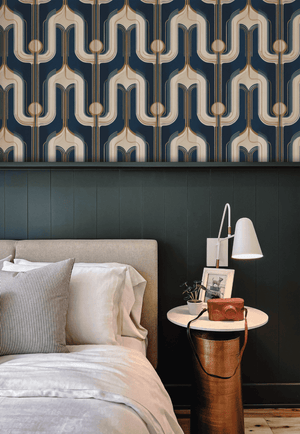
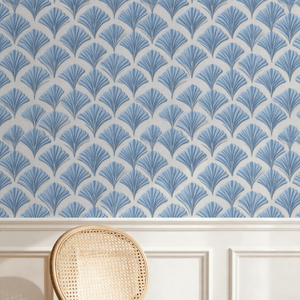
Our pick is asanoha, because the star holds together at almost any scale, with sayagata a close second as a quiet ground. Kikko is the one to choose if you want the meaning without an obviously Japanese look, since from across a room it reads as honeycomb.
Take a narrow hallway, 3 feet wide and 14 feet long. Nobody stands far enough back in a space like that to take in a big scenic print, so it turns into a smear of color at shoulder height. A small sayagata, a couple of inches per unit, does better. Up close the fret is crisp. It runs the full length of the hall without ever looking busy, the way it sat quietly under the flowers on Edo rinzu. We'd keep it tone on tone, two close shades of one color, so it shows when light rakes along the wall and goes quiet when it doesn't.
Asanoha wants a wall you face head on, the one behind a bed. At around 4 inches a star, it reads as stars from the pillow and as texture from the door. Early Edo komon was often white on blue. We'd still start there.
Japanese pattern questions
What does wagara mean?
Wagara means traditional Japanese patterns, from wa, "Japanese-style," and gara, "pattern." In Japan you'll see the word on anything from kimono fabric to tenugui cloths.
Is the sayagata pattern a swastika?
Sayagata is built from the manji, the Buddhist form of the ancient good-fortune sign that English calls the swastika. The manji was in Japanese art by 697, more than twelve centuries before the Nazi Party adopted its own tilted version in 1920, and in Japan it has stood for prosperity and a long life.
Which Japanese pattern means good luck?
Shippo is the clearest case, its unbroken circles standing for prosperity that continues. Kikko's long-life wish comes a close second (and it's the one you'll spot on family crests).
Are Japanese patterns originally Chinese?
Many are, at least in part, kikko and sayagata among them. Asanoha is the twist: its geometry was common across Asia, but only Japan saw a hemp leaf in it.
How were Japanese patterns printed on cloth?
Mostly with katagami, paper stencils used to lay down a rice-paste resist before dyeing. Cooper Hewitt says the craft is documented since at least the sixteenth century.


