


What Is Gothic Revival?
Gothic Revival is the style that brought the pointed arch, and the medieval ornament that came with it, back into architecture and decoration, starting in 18th-century England and reaching its height in 19th-century Britain and America. Britannica names Horace Walpole's house at Strawberry Hill as the earliest documented example. The serious phase took hold in the 19th century, and after fire wrecked the old Palace of Westminster in October 1834, the new Houses of Parliament by Charles Barry and A.W.N. Pugin became the style's best-known landmark. Pugin's flat, heraldic wallpapers for that building are still, to our eye, the clearest model of a Gothic Revival room, and the movement's arguments about honest handwork fed straight into the Arts and Crafts movement.

John Gregory Crace, designed by A.W.N. Pugin, Design for the Decoration of the Drawing Room at Eastnor Castle, Herefordshire, ca. 1850. Public domain, via The Metropolitan Museum of Art.
Where did Gothic Revival begin?
Gothic Revival began in England in the early 18th century, when Gothic details started turning up on garden buildings and in single rooms as a light, decorative fashion that owed more to Rococo than to the Middle Ages. Historians often spell that early version "Gothick," with a k. William Kent used it in 1732 on a gateway at Hampton Court.
Then came Walpole. In 1747 he bought a small house on the Thames at Twickenham, and by January 1750 he was telling a correspondent he meant to build a little Gothick castle there. It took him nearly 30 years.
He didn't hand the job to one architect. He set up what he called a Committee of Taste with the designer Richard Bentley and the amateur architect John Chute, and they borrowed freely from engravings in Walpole's library. The entrance hall's carved stone walls are really painted paper, taken from an engraving of Prince Arthur's chantry tomb in Worcester Cathedral. When Walpole finally saw the real tomb, he complained that it was smaller than his paper, and whitewashed.
The furniture played along. Eight black chairs made for the Great Parlour in 1755 have backs shaped like Gothic windows, painted to pass for ebony.
Others went bigger. James Wyatt's Fonthill Abbey in Wiltshire, built from 1796 to 1806, lost its central tower to collapse in 1807. That's Gothick in one sentence: all effect, not much structure.
When did Gothic Revival become a serious style?
Gothic Revival turned serious in the 1830s and 1840s, when church building boomed and a young architect named A.W.N. Pugin argued that Gothic was the only honest, Christian way to build.
Two ideas carried that argument. A society shows in the quality of its buildings, he argued, and decoration should relate to what a thing is actually for. The rest of his story, conversion and books included, is in our Augustus Pugin guide.
His rules traveled. Britannica credits his St. Oswald's in Liverpool (1839, since demolished) with setting the pattern for Gothic Revival parish churches in England and abroad.
Why is the Palace of Westminster Gothic Revival?
The Palace of Westminster is Gothic Revival because Parliament asked for it: after the fire of 16 October 1834, a parliamentary committee ruled that the new palace should be Gothic or Elizabethan, and Charles Barry won the 1835 competition with a Gothic design.
Only Westminster Hall and a handful of older pieces survived. Barry's wife laid the new building's first stone in 1840.
Pugin had drawn for Barry's competition entry as a hired draftsman, then left for his own work. In 1844, Parliament's heritage team notes, he was invited back to design the interiors, and until his death in 1852 he turned out designs for nearly everything you can touch inside. Even the plain oak chairs he drew for the House of Commons kept to his rule about use, upholstery nails left in plain sight.
Around a hundred of those designs were wallpapers. Picture the one from 1848, a crowned Tudor rose and portcullis repeating in gold and red across a dark-red ground, with the letters VR, for Victoria Regina.

A.W.N. Pugin (designer) and Holland & Sons (maker), Dining room chair from the Speaker's House, Palace of Westminster, 1859. Public domain, via The Metropolitan Museum of Art.
What did John Ruskin have to do with Gothic Revival?
John Ruskin gave Gothic Revival a moral case and a new model in Venice, mostly through The Stones of Venice, published in three volumes from 1851 to 1853. He used Venice's carved details to argue that its Gothic grew from a healthy, unified culture his own century had almost lost.
The chapter everyone remembers is "The Nature of Gothic," the sixth chapter of the second volume. Ruskin's larger claim was that the quality of medieval craftsmanship reflected a morally better way of life, and he wanted those conditions back.
A student at Oxford in the 1850s named William Morris read it, and by Britannica's account the chapter came to him "with the force of a revelation." In March 1892 Morris printed it as a book of its own at his Kelmscott Press. Ruskin's wider life is covered in our John Ruskin guide.
What does Gothic Revival architecture look like in America?
American Gothic Revival runs from stone churches in the cities to wooden cottages in the country, and it took hold in the 1830s and 1840s.
Robert Gilmor toured England and Scotland and came back taken with Strawberry Hill and Sir Walter Scott's Abbotsford. Alexander Jackson Davis designed the Gothic ornament for his house, Glen Ellen, at Towson, Maryland, and the Met calls it the first truly Picturesque Gothic home in America. It was demolished in the 1930s.

Alexander Jackson Davis, Glen Ellen for Robert Gilmor, Towson, Maryland (perspective, elevation, and plan), 1832. Public domain, via The Metropolitan Museum of Art.
In New York, Richard Upjohn's Trinity Church, built 1839 to 1846, made his reputation with its clean Perpendicular Gothic lines. Upjohn was so sure Gothic was the only Christian architecture that he refused to design a church for the Unitarians.
Out in the country the style went wooden. Andrew Jackson Downing's style books, such as Cottage Residences (1842), helped make it popular, and the powered scroll saw made fancy trim easy to turn out. That's Carpenter Gothic. Look for steep gables and pointed windows. The siding is often vertical board-and-batten, and the gable edges carry sawn bargeboards, the "gingerbread."
You already know one of them. Charles and Catherine Dibble built a house in Eldon, Iowa, in 1881 to 1882, with a Gothic window on the front and another on the back. Grant Wood saw it in the summer of 1930 and made it the backdrop for American Gothic, a farmer and his daughter posed stiffly before a Carpenter Gothic home.
How do you recognize Gothic Revival style?
You can recognize Gothic Revival by the pointed arch first, since in a Gothic Revival building it almost always arrives with medieval ornament attached.
Tracery comes next. It's the stone ribs that divide a Gothic window into smaller openings, and when it runs across a wall in relief, with nothing to see through, it's called blind tracery. Inside the tracery sit foils (the word comes from the Latin for leaf). A trefoil has three lobes and a quatrefoil has four, the shape our quatrefoil guide covers in detail.
Crockets are easy once you've seen one. They're the small leafy knobs that climb the edges of spires and gables in rows.
Flat surfaces carry heraldry. At Westminster the crowned portcullis stands for the palace and the Tudor rose for the Crown, and the fleur-de-lis turns up even on the palace's cast-iron weathervanes. Our fleur-de-lis guide has the motif's longer story.
Then there's diaper, an allover grid of small repeated motifs. Pugin liked it. A tile of his from the House of Commons, laid in 1850, sets fleurs-de-lis in a diaper, and an 1851 furnishing damask he designed carries a Gothic diaper of roses.
What does Gothic Revival wallpaper look like?
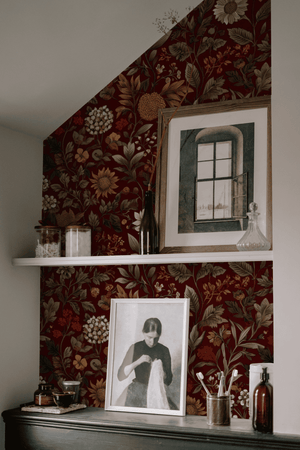
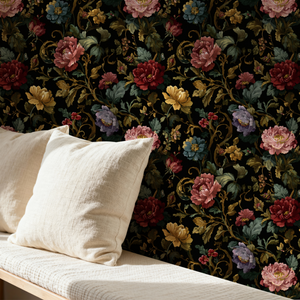
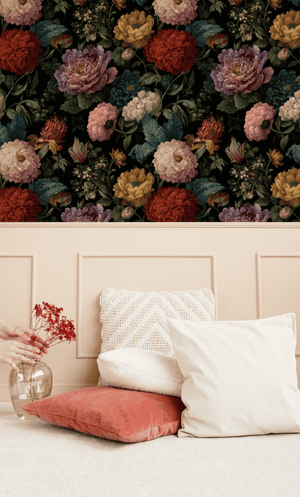
Gothic Revival wallpaper is flat, formal pattern drawn from medieval sources such as heraldry and old woven silks, usually printed in strong color with no shading at all. It didn't start out that way, though.
Walpole's hall at Strawberry Hill, done in its first phase by 1753, was papered with Gothic fretwork painted in perspective to look carved. By the middle of the next century the shops were full of a different illusion, realistically shaded cabbage roses. Pugin argued that a three-dimensional pattern on a flat, solid wall gave a dishonest impression of depth, and his own papers stuck to medieval and heraldic motifs. Owen Jones, another reformer, went a different way and reduced flowers to formal, symmetrical shapes.
Not that buyers listened. The V&A says the reformers' views never really took hold outside the design establishment.
The color surprises people. Pugin worked in bright primary colors and simple regular repeats, and when he redesigned rooms at Eastnor Castle in Herefordshire in 1849 to 1850, Crace's watercolor of the drawing room (at the top of this page) shows green patterned walls under a blue fan-vaulted ceiling picked out in gold. Gloomy it isn't. Our history of wallpaper puts these papers in the longer story.
We'd use the look where there's wood and books. Take a 12-by-14-foot study with a north window and oak shelves on one long wall. A small, flat heraldic or diaper-style repeat on the other three walls reads as texture from the desk and as pattern up close, and the oak stops it from feeling like a vestry. Deep red or green, not black. Skip the oversized tracery (that's a chapel, not a study). For the period without the heraldry, our Victorian wallpaper is the nearest neighbor, and dark academia wallpaper leans into the library mood these rooms do so well.
How did Gothic Revival lead to the Arts and Crafts movement?
Gothic Revival led to the Arts and Crafts movement largely through one Oxford office: after taking his degree in 1856, William Morris joined the practice of the Gothic Revival architect G. E. Street, and that is where he met Philip Webb.
Street was known above all for his Gothic Revival churches. Morris didn't last long at the drawing board, mind you. Dante Gabriel Rossetti talked him into painting instead.
Webb stayed with architecture. After Morris married in 1859, Philip Webb designed Red House at Bexleyheath for him, in red brick when stucco villas were the fashion.
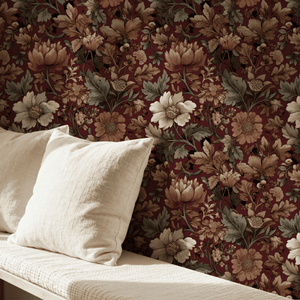
Morris's wallpapers show the debt and the break. The V&A sees them as a compromise, flatter than the shaded cabbage roses but looser than the reformers' geometry. Where Pugin worked from rules taken out of historical examples, Morris drew natural forms from direct observation. His firm even printed a wallpaper called Diaper around 1870, squares of leaf scrolls alternating with squares of flowers. To us, his papers are Gothic Revival's best-behaved child. Hedgerows instead of heraldry.
How is Gothic Revival different from Victorian Gothic and Gothic architecture?
Gothic architecture is the original medieval style, built in Europe from the mid-12th century to the 16th; Gothic Revival is the later reinterpretation, and Victorian Gothic usually means the revival in Queen Victoria's day, especially its bolder High Victorian phase.
Medieval builders were solving an engineering problem. The pointed arch and the flying buttress let them build very tall and still fill the inside with light. Walpole's Gothick borrowed the look without the engineering, which is why his stone could be paper. The 19th-century revival worked much harder at getting the details right, and Britannica credits it with a lasting idea, honest structure, that modern architects later took up.
Victorian Gothic got louder as it went. William Butterfield's All Saints, Margaret Street, in London (1849 to 1859) is banded in contrasting brick and lined with marble and tile, the structural polychromy that became the fashion of the later Victorian years. If Pugin's Gothic is English and exact, this one is striped and confident. We like both. They're just not the same thing.
Gothic Revival questions
When was the Gothic Revival period?
Britannica dates the Gothic Revival to roughly 1750 to 1880. Its own survey of Western architecture stretches that to about 1730 to 1930, so you'll see both ranges quoted.
Who started the Gothic Revival?
Horace Walpole usually gets the credit, for rebuilding Strawberry Hill at Twickenham from 1747. William Kent's Gothick gateway at Hampton Court came first, in 1732, but Walpole did a whole house.
Is Carpenter Gothic the same as Gothic Revival?
Carpenter Gothic is the wooden, mostly cottage-sized branch of American Gothic Revival, trimmed with scroll-sawn ornament. Typical paint schemes paired tan with dark brown, or warm gray with slate gray.
Were Gothic Revival interiors dark?
Gothic Revival interiors were often brightly colored rather than dark, and Pugin's wallpapers used bright primary colors in simple regular repeats. Walpole's parlor chairs went the other way, painted black to pass for ebony.
Are Pugin's Westminster wallpapers still made?
Pugin's Westminster wallpapers are still made, as exact replicas printed from the original Victorian blocks. His design still covers the walls of the Cholmondeley Room in the House of Lords.


