


What Is the Aesthetic Movement?
The Aesthetic Movement was a British art and design movement of roughly the 1860s to the 1890s that prized beauty for its own sake, holding that a painting or a wallpaper needed no moral lesson to justify it. Its slogan, art for art's sake, came over from the French l'art pour l'art. Tate says it flourished in Britain in the 1870s and 1880s, in painting and the applied arts alike. Whistler was its sharpest painter, and Oscar Wilde its loudest voice. In middle-class parlors it meant blue-and-white china on the mantel and walls split into bands of pattern, until Wilde's conviction in 1895 finished it with the public.

James McNeill Whistler, Harmony in Blue and Gold: The Peacock Room, 1876 to 1877. Public domain (CC0), via the Smithsonian's National Museum of Asian Art.
What does "art for art's sake" mean?
Art for art's sake means a work of art is justified by its beauty alone and owes nobody a lesson or a use. Britannica credits the philosopher Victor Cousin with coining l'art pour l'art in 1818, but the poet Théophile Gautier turned it into a cause, in books like Mademoiselle de Maupin (1835).
England got its own version in 1873, when the Oxford don Walter Pater published Studies in the History of the Renaissance. Its closing essay argued that art exists for its beauty and nothing else. That ending is the part people remembered.
One reader took it personally. Oscar Wilde, at Magdalen College from 1874, filled his rooms with objets d'art and joked that he could hardly live up to his blue china. Ruskin, whom Wilde also admired, thought art cut loose from morality was a problem. That argument ended up in court.
Who were the main Aesthetic Movement artists?
The main Aesthetic Movement artists were Dante Gabriel Rossetti's circle and the American-born James McNeill Whistler, while designers such as E. W. Godwin and Christopher Dresser carried the ideas into the home. The seeds were sown by the Pre-Raphaelite Brotherhood, active from 1848.
Dante Gabriel Rossetti started a second Pre-Raphaelite phase in the late 1850s with two younger men, Burne-Jones and William Morris. His later pictures, The Blessed Damozel among them, trade storytelling for sensuous mood and color, which is about as good a definition of Aesthetic Movement art as you'll find.
Edward Burne-Jones painted languid knights and enchantresses out of medieval romance. His first big success came at an exhibition in 1877, and from then on he was counted among England's great painters.
The poetry came from Algernon Charles Swinburne, who had fallen in with the Pre-Raphaelite set at Oxford. His Poems and Ballads of 1866 was savaged for its sensuality and loved by younger readers. Punch called him Mr. Swineborn.
Albert Moore belongs on the list, and so do some of Frederic Leighton's pictures. Whistler, though, is the one who made the argument out loud.
What was Whistler's role in the Aesthetic Movement?
Whistler was the Aesthetic Movement's most uncompromising painter, and he defended art for art's sake in court as well as on canvas. He gave his paintings musical titles like symphony and harmony, borrowing music's claim to mean nothing beyond itself.
His great room is the Peacock Room. In 1876 the Liverpool shipowner Frederick Leyland had a dining room at 49 Prince's Gate in London, lined by the architect Thomas Jeckyll with walnut shelves for Chinese blue-and-white porcelain. Jeckyll fell ill. Leyland went home to Liverpool. Whistler, asked for advice on colors, kept going.
He covered the ceiling in imitation gold leaf and peacock feathers and gilded the shelving. When Leyland balked at the fee, Whistler painted the costly antique leather on the walls Prussian blue and added two fighting peacocks, one with silver throat feathers like the ruffled shirts Leyland wore. Charles Lang Freer bought the room in 1904, and it has been on permanent display at the Freer Gallery of Art in Washington since 1923.
The courtroom came next. In 1877 the new Grosvenor Gallery showed Whistler's Nocturne in Black and Gold: The Falling Rocket, and Ruskin accused him of "flinging a pot of paint in the public's face." Whistler sued for libel. At the trial in November 1878 he won and was awarded a single farthing, with no costs. The bills pushed him into bankruptcy in 1879, and he had to leave the White House, the Chelsea home Godwin had designed for him.
Bad for Whistler. On the bigger question, whether a painting owes anyone a story, history has mostly taken his side.
How did Japan influence the Aesthetic Movement?
Japan gave the Aesthetic Movement much of its look, above all asymmetry and flat, simplified pattern. Japonisme had a starting date of sorts. Japan was forced open to foreign trade in 1853, and London's 1862 International Exhibition gave the public a whole Japanese Court to look at.
Christopher Dresser studied that display closely and became a recognized authority on Japanese art. In 1876-77 he went to Japan himself, carrying a gift of art manufactures for the museum now called the Tokyo National Museum. By the late 1870s he was dealing in Japanese imports.
E. W. Godwin got there first, at least at home. Around 1861 he decorated his own house in the Japanese manner, the first of its kind in Britain. In 1867, by then in London, he designed an ebonized sideboard for his dining room, all black rectangles and open space. It's now one of the most famous pieces of nineteenth-century furniture, and the style got a name, Anglo-Japanese. Modernists loved it later, and it isn't hard to see why.

Edward William Godwin, side table, about 1872. Public domain, via The Metropolitan Museum of Art.
Then there was the china. Old Asian blue-and-white porcelain was the Aesthete's trophy, and London's papers had a name for the craze: Chinamania. Leyland's collection was the whole reason his dining room had shelves.
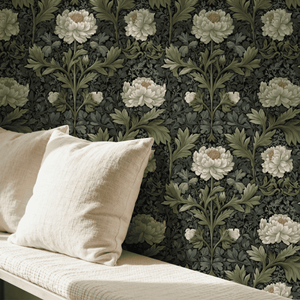
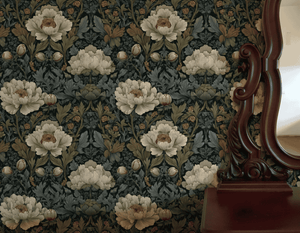
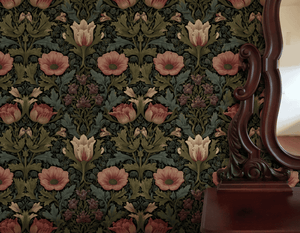
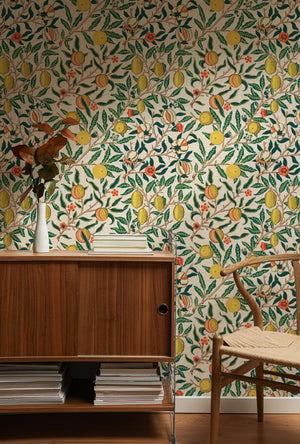
Why are peacock feathers and sunflowers Aesthetic Movement symbols?
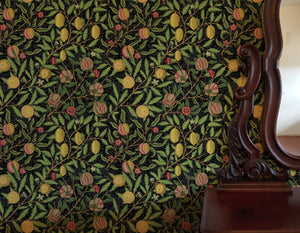
Peacock feathers and sunflowers became Aesthetic Movement symbols because the movement's designers used them everywhere, and by the early 1880s satirists and shopkeepers had made them shorthand for the whole thing. The peacock feather stood for the rare and the exotic. The sunflower got a boost from Thomas Jeckyll, whose Japanese pavilion at the 1876 Centennial Exhibition in Philadelphia had a railing of wrought-iron sunflowers. Pale lilies were the third emblem.
Shops did the spreading. Arthur Lasenby Liberty opened his shop on Regent Street in 1875, selling Japanese and Indian fabrics, and in 1887 Arthur Silver designed a peacock-feather cotton for the store that's still one of the key Aesthetic textiles. The later prints carrying the shop's name are covered in our guide to the Liberty floral.
Then came the jokes. George du Maurier had been drawing Aesthetes for Punch since 1876, and in 1881 Gilbert and Sullivan's Patience put them on stage, swooning over lilies. Its poet Bunthorne was based partly on Wilde, who leaned in. In 1882 he lectured across the United States and Canada, spending 12 months urging Americans to care about beauty, in velvet and knee breeches. The story goes that he told New York customs he had nothing to declare except his genius.
What did Aesthetic Movement interior design look like?
Aesthetic Movement interior design started at the walls, where the paper was often split into three coordinated bands, each with its own job. The V&A's account of furnishing the Aesthetic home sets it out. The dado ran along the bottom, below the chair rail, and was often geometric. Above it came the filling, the deepest band, kept light and leafy because pictures hung against it from the picture rail. The frieze sat nearest the ceiling, bolder and brighter.
Sets of Aesthetic Movement wallpaper were designed to work together across the three bands, and the fashion for dividing walls this way dates to the late 1860s. Charles Eastlake described it in Hints on Household Taste in 1868, and by the 1880s it was commonplace. A writer in the Journal of Decorative Art put the rule plainly in 1886: "The frieze should be light and lively."
Walter Crane designed for every band, having started on wallpaper in 1874 at Bruce Talbert's suggestion. His Swan, Rush and Iris (designed 1875) is a dado. His daisy-strewn La Margarete went to the Philadelphia exhibition of 1876 alongside an Alcestis frieze and a Dove dado. Peacocks and Amorini (1878), below, is a frieze, embossed and gilded to pass for leather.

Walter Crane, Peacocks and Amorini frieze, 1878. Public domain (CC0), via Cooper Hewitt, Smithsonian Design Museum.
Talbert designed sets too. His display panel of 1877, now at the V&A, prints all three bands on one sheet, with apples and butterflies along the frieze and trellis and fan shapes down in the dado. Not everyone liked the effect. Morris, whose layered Jasmine paper of 1872 set the standard for Aesthetic foliage patterns, disapproved of how busy these walls were.
How is the Aesthetic Movement different from Arts and Crafts?
The Aesthetic Movement wanted beauty for its own sake, while the Arts and Crafts movement tied beauty to a social and moral purpose, from the dignity of handwork to the reform of ordinary household goods. Arts and Crafts, inspired by Ruskin and Morris, set out to revive traditional handicrafts and a simpler way of living. Aesthetic taste had no quarrel with a factory, so long as the result was beautiful.
William Morris is where the neat line breaks down. The V&A counts him among the first Aesthetic artists, while Britannica lists him with Ruskin among the movement's critics. Both are right. Morris shared the Aesthetes' eye and almost none of their indifference to what art was for.
The potter William De Morgan sat on the same fence. He began as a designer for Morris's firm, yet he made tiles for the Arab Hall at Frederic Leighton's house in Kensington, about as Aesthetic as a room gets. Crane, after all those friezes, became the first president of the Arts and Crafts Exhibition Society. Our view: the two movements shared designers and argued mainly about why any of it mattered.
How did the Aesthetic Movement lead to Art Nouveau?
The Aesthetic Movement fed straight into Art Nouveau, and in Britain the new style owed most to two forerunners, this one and Arts and Crafts. The peacock feathers survived the handover. So did the Japonisme.
Wilde's imprisonment in 1895 turned the public against the Aesthetes, but by then they had already shaped Crane and Aubrey Beardsley. Louis Comfort Tiffany and Victor Horta felt it abroad. Liberty made the same trip. The shop later helped popularize art nouveau, and in Italy the style was called Stile Liberty. Our guide to Art Nouveau picks up from there.
How can you bring an Aesthetic Movement look into a room?
Start with the wall, the way the Aesthetes did, by splitting it into bands, then let dark wood and blue-and-white china carry the rest. It's calmer than full Victorian maximalism, which piles pattern on pattern. Here each band gets one pattern and one job.
Take a dining room with 9-foot ceilings and a chair rail at about 32 inches. Paint the dado a deep olive. Between the chair rail and a picture rail you'll have a little over five feet of filling, and that wants a quiet, leafy pattern with two layers of growth (an Arts and Crafts wallpaper close in spirit to Morris's Jasmine is the right kind). Give the top 14 inches or so to the frieze. Up there you can be loud. A bold design from the bird wallpaper collection, cut into a strip, gets you near the spirit of Crane's peacocks.
Then the furniture, light in build and ebonized. One hanging cabinet or an overmantel will hold the blue-and-white, and back then a single Japanese fan on the mantelpiece was how buyers on a modest budget joined in. We'd hang the pictures on cords from the picture rail, as intended.
In a small room, skip the frieze and run one quiet Victorian wallpaper above a painted dado. Still Aesthetic. Just calmer.
Aesthetic Movement questions
When did the Aesthetic Movement start and end?
The Aesthetic Movement ran from about the 1860s to the mid-1890s, peaking in the 1870s and 1880s. The V&A gives 1860 to 1900, but Wilde's conviction in 1895 effectively ended it as a public fashion.
Who first wrote about the Aesthetic Movement?
The critic Walter Hamilton was the first writer to identify the movement, in his 1882 book The Aesthetic Movement in England. He was writing from the middle of it, the same year Wilde toured America.
What colors are typical of the Aesthetic Movement?
Aesthetic wallpapers leaned on reddish pinks and greenish blues, with plenty of olive. The Peacock Room is the loud exception, all Prussian blue and gold.
Where can you see the Peacock Room today?
The Peacock Room is at the Freer Gallery of Art in Washington, DC, part of the Smithsonian's National Museum of Asian Art. It has been on view there since the gallery opened in 1923.
Is the Aesthetic Movement the same as Aestheticism?
Mostly, yes, and the V&A uses both names for the same thing. Strictly, Aestheticism is the wider European idea, with roots Britannica traces to Kant, while the Aesthetic Movement usually means its British art and design form.


