


Who Was John Henry Dearle?
John Henry Dearle (1859-1932) was the English designer who joined William Morris's firm as a teenage showroom assistant in 1878 and became its art director after Morris died in 1896. Morris trained him as a tapestry weaver, and by 1890 he was the firm's head designer. He drew the flowering backgrounds behind Edward Burne-Jones's knights in the Holy Grail tapestries. He also designed Golden Lily, a wallpaper still printed today under Morris's name. That's the odd thing about Dearle. A lot of his best work carries his employer's name, and he's far less famous than the people he worked beside in the Arts and Crafts movement.

John Henry Dearle for Morris's firm, Greenery, tapestry designed 1892 (Museum of Fine Arts, Boston). Public domain, via Wikimedia Commons.
How did John Henry Dearle start working for William Morris?
John Henry Dearle started in 1878 as an assistant in the firm's showroom on Oxford Street in London, selling Morris's goods rather than designing them. The shop itself was new, opened only the year before.
He was born in Camden, London, in 1859. (A few catalog entries, two of them at the V&A, say 1860, but the Met and the William Morris Gallery both give 1859.) Past that, his childhood is close to a blank in the museum records we read, and we'd rather leave it blank than guess.
The counter didn't hold him long. The firm moved him to the glass painters' studio, and from there Morris took him on as an apprentice tapestry weaver, the first he ever had. The V&A puts his age at 19 when that happened. George Wardle, who managed the business for Morris, wrote later that Morris was swayed by how bright and intelligent the boy was.
A good bet, as it turned out.
How did William Morris train Dearle in tapestry weaving?
Morris taught him in person, first at the firm's Queen Square workshops and then at Merton Abbey, where tapestry weaving moved in 1881. Morris wasn't far ahead of his pupil. He had set up his first tapestry loom in 1877 and finished his first piece, Acanthus and Vine, in 1879, after 516 and a half hours at the loom that he recorded himself (of course he did).
Merton Abbey was an old textile-printing works near Wimbledon, with soft water from the River Wandle and room for the big indigo vats Morris wanted. When the looms moved there, Morris put Dearle in charge of tapestry production. He was in his early twenties.
The teaching then passed down a generation. Dearle trained the apprentices who came after him, and Wardle put it bluntly: "Dearle was the teacher of all who followed him." The V&A still keeps a small panel in indigo-dyed wool that's probably one of those beginner pieces. Apprentices wove little trials like it, then simple finished panels, before anyone let them help on a full-size hanging.
What did John Henry Dearle do on the Holy Grail tapestries?
John Henry Dearle designed the backgrounds and floral details of the Holy Grail tapestries, an Arthurian set woven at Merton Abbey between 1891 and 1894 for Stanmore Hall in Middlesex. Edward Burne-Jones drew the figures. Morris handled the heraldry. The client was William Knox D'Arcy, who commissioned the set in 1890 for his dining room, and it was the last interior commission Morris worked on.
That split matters more than it sounds. Burne-Jones's knights and angels get the attention, but the flowers at their feet and the woods behind them came from Dearle.
Burne-Jones worked small. The firm blew his final designs up photographically to the full size of the finished tapestry, and he went over the enlargements in ink before weaving began. The firm went on to weave two more versions with minor differences. Frederick Hollyer's photographs of the originals may even have hung in the showroom as advertising.
Our favorite panel in the series has no knights in it. It's the verdure, a long stretch of woodland with deer, where the knights' shields hang from the trees, and it's mostly Dearle's work.

John Henry Dearle after Edward Burne-Jones, with heraldry by William Morris, Verdure with Deer and Shields from the Holy Grail series, this version woven 1900 (Birmingham Museum and Art Gallery). Public domain, via Wikimedia Commons.
In 1894 he did the same job on a single hanging, Angeli Ministrantes, adding a background and border to angels Burne-Jones had drawn in 1877 and 1878 for windows in Salisbury Cathedral. Churches liked it. The firm went on weaving variations of it for years.
Did John Henry Dearle design The Forest and Greenery tapestries?
Dearle shared the credit for The Forest (1887) with Morris and Philip Webb, and he designed Greenery (1892) on his own. On The Forest, the V&A's best reading is that Morris drew the acanthus leaves and Webb the five animals and birds. Dearle probably added the flowers in the foreground, though the museum hedges, since they look a lot like Webb's own preparatory drawings.
The firm's three most senior weavers made The Forest. Aleco Ionides bought it for 1 Holland Park, his house in London, where it hung in the study, and the V&A bought it from his heirs in 1926.
Greenery tells you more about Dearle. According to the Met, he drew it in 1892 imitating Morris's manner in the trees and Webb's in the animals. Morris wrote three riddles for it, each spoken by a tree about what its wood would become. The pear expects to be carved. The chestnut ends up as roof rafters, and the oak goes to sea in a sailing ship.
The Met's copy wasn't woven until 1915, twenty-three years after the drawing. John Martin wove it, and a weaver of that name had worked on The Forest back in 1887. It runs 15 feet 5 inches across. We'd call it the best evidence of how completely Dearle had absorbed both older men, and still made something of his own.
When did Dearle become art director of Morris's firm?
Dearle became art director in 1896, after Morris died, though he'd been the firm's head designer since 1890. The handover started earlier than either date. Morris's last identifiable designs for woven cloth were drawn in 1888, and after that, the V&A says, woven textiles were Dearle's responsibility.
Morris was busy elsewhere by then. He'd helped found the Socialist League in 1884 and was giving more of his time to politics and writing. Merton Abbey was left more and more to Dearle and other senior staff, his daughter May among them.
May Morris had run embroidery since 1885, when she was 23. So the firm ended up with something like a divided desk, May on embroidery and Dearle on design and the Merton workshops. They overlapped, naturally. Dearle drew embroideries too, such as The Owl, a silk wall hanging he designed around 1895 that a Mrs. Battye stitched a few years later.
After 1896 the title matched the work. He kept it until he died, thirty-six years later.
What wallpapers did John Henry Dearle design?
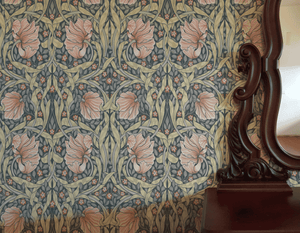
Golden Lily is the John Henry Dearle wallpaper we'd point to first, and the V&A's records credit him with plenty more, Seaweed and Persian among them. The William Morris Gallery dates Golden Lily to 1899. Its own sample came off the walls of a room at St. Ives House, near Ringwood in Hampshire, papered that same year.

John Henry Dearle, Golden Lily wallpaper, block-printed 1899 (Cooper Hewitt, Smithsonian Design Museum). Public domain, via Wikimedia Commons.
The lilies have petals shaped like fleurs-de-lis, twisting through scrolling leaves. The teal Golden Lily we print sets pale lily heads on a dark stippled ground, so the field shimmers and the flowers only separate as you get close. The green version is quieter, blue-gray lilies on ivory, and the drawing carries it.
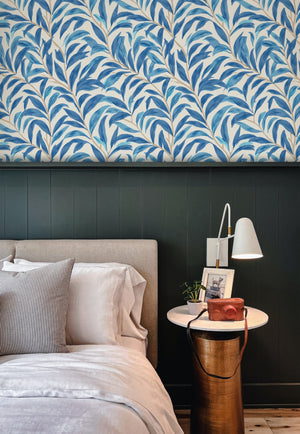
Seaweed is the one we'd misjudge from the name alone. The V&A dates a specimen in one of the firm's pattern books to 1901, and the 1950s reprint it holds is barely marine at all. It's mostly green foliage on a dark blue ground, with two big undulating yellow stems running through it.
Daffodil began as a printed cotton around 1891. The William Morris Gallery calls it one of his most successful early patterns and keeps ten of the woodblocks used to print it. It pairs the strong diagonal repeat Morris favored with Dearle's own flowers, and the V&A holds a Daffodil wallpaper credited to him as well.
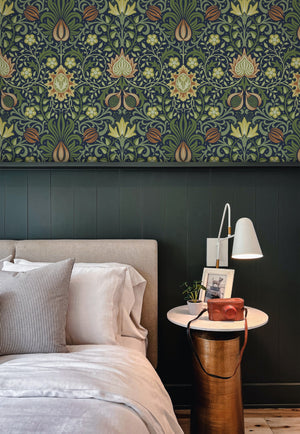
Persian followed in 1904. The gallery ties it to an interest Dearle had shown since Morris began stepping back in the late 1880s, when his patterns turned to strong symmetrical forms and to Iranian and Turkish sources. It was printed in a green colorway and a blue one. The green Persian we print has mirrored stems that stack into columns up the wall.
Those columns decide where we'd hang it. Take a narrow hallway with an 8-foot ceiling. We'd put Persian there, because columns pull the eye upward and the ceiling seems to lift. Golden Lily we'd save for a north-facing bedroom, in the green version, where the ivory ground keeps a dim room from feeling smaller than it is.
Why are John Henry Dearle's designs often credited to William Morris?
Dearle's designs get credited to Morris mostly because he spent his whole career inside a firm that carried Morris's name, and some of his patterns were taken for Morris's own for many years. Compton is the famous case. Laurence Hodson had the firm redo the interiors of Compton Hall, his house outside Wolverhampton, in 1895 and 1896, and the pattern was registered as a wallpaper and a printed cotton on 27 February 1896.
May Morris recorded it as her father's last repeating design. Then Linda Parry, in her 1995 book William Morris Textiles, set out evidence that Dearle drew it. The William Morris Gallery now credits him, partly because Compton looks so much like his Leicester wallpaper. Surviving letters show Morris had a hand in some of the house's designs, but the gallery finds no sign he was the sole designer of any of them.
Even the V&A's records don't agree with each other. Its Compton wallpaper specimens are cataloged under Morris, with Dearle added and Parry's evidence quoted. Its Compton fabrics are simply Dearle's.
Our own catalog follows the old convention. Golden Lily and Persian sit in our William Morris collection as designs from Morris's firm, and so does Sweet Briar, which the V&A also credits to Dearle. The drawing in all three is his. There's no reliable visual tell, either (symmetry won't settle it, since some of Morris's own patterns are mirrored), so the museum record is the place to check.
When did John Henry Dearle die?
John Henry Dearle died in 1932 in Purley, Surrey, still the firm's art director. His son Duncan William Dearle (1893-1954) succeeded him as chief designer and artistic director.
Duncan's heart was elsewhere, by the William Morris Gallery's account. He'd studied music composition at Heidelberg before the First World War and became an organist and composer. Edward Pain, who worked for the firm, remembered him as more interested in music than design, spending his time on the clarinet. Only three designs by Duncan are known.
His father's patterns did better. In July 2023 Walthamstow Football Club released shirts based on Yare, a textile Dearle designed in about 1892, and they sold out within days. The V&A now has one of those shirts in its collection, which feels about right for a man who started out behind a shop counter.
John Henry Dearle questions
Did John Henry Dearle design Golden Lily?
Yes, Golden Lily is Dearle's design, and the William Morris Gallery dates it to 1899. Morris had died three years earlier, so he never saw it.
Is Seaweed wallpaper by William Morris or John Henry Dearle?
Seaweed is by John Henry Dearle, and the V&A dates a specimen of it to 1901. That specimen sits in one of the firm's old pattern books, 132 samples bound together and mounted on a display stand.
Where can you see John Henry Dearle's work today?
The V&A in London holds The Forest and Angeli Ministrantes, and the Met in New York owns a Greenery tapestry. In Walthamstow, the William Morris Gallery keeps his Daffodil design for printed cotton (the full Holy Grail series, the gallery says, belongs to Birmingham Museum and Art Gallery).
What else did John Henry Dearle design besides wallpaper?
John Henry Dearle also designed carpets and stained glass. The large Bullerswood carpet of about 1889, now at the V&A, is credited to Morris and Dearle together.


