


What Is The Arts And Crafts Movement?
The Arts and Crafts movement was a late-1800s revolt against the machine, led by William Morris, that insisted a wallpaper or a chair deserved as much care as a painting. It got going in Britain in the 1860s, hit full stride through the 1880s and 1890s, and kept shaping design into the 1920s. Morris was the engine of it. The critic John Ruskin handed it the ideas. And what it fought was everything cheap and stamped-out that the factories had started pouring into Victorian homes.

This guide walks through what the movement was, when it began, who started it, what it stood against, how it differed from Art Nouveau, how it faded, where it spread, and what it left us.
What was the Arts and Crafts movement?
Picture a workshop instead of a factory floor. A few people, skilled, unhurried, making a thing all the way through by hand. That's the movement in one image: designers, architects, and makers who thought everyday objects should be built like that, not stamped out a thousand an hour. They'd had enough of the flimsy goods piling up in Victorian shops, and their answer was almost stubbornly simple. Good design for everyone. Pride for whoever makes it. Patterns pulled from the garden, not copied off some dead style.
It reached into every corner of a house, from the wallpaper to the chairs to the stained glass to the roof over your head. And whatever it touched had to be honest about itself. Oak looked like oak. A metal hinge wore its hammer marks. Wallpaper didn't pretend to be tapestry. That honesty was the whole quarrel, really, a flat refusal to let a cheap thing masquerade as a grand one. The V&A traces the name to a single body: the movement, it notes, "took its name from the Arts and Crafts Exhibition Society".
When did the Arts and Crafts movement begin?
Britain, the 1860s, though a book lit the fuse a decade earlier. John Ruskin wrote it. His essay "The Nature of Gothic" came out in 1853, and the argument sounds mild until you sit with it: a medieval craftsman had the better life because he owned his work start to finish, unlike the poor soul repeating one motion on a factory line. Nearly every Arts and Crafts thinker afterward read that and nodded.
The proof turned up at the end of the decade. Philip Webb built Red House for Morris across 1859 and 1860, and in 1861 Morris opened his firm. Now there was a house to point at and a workshop to order from.
The 1880s got it organized, first the Century Guild in 1882 and then the Art Workers Guild in 1884. In 1888 the Arts and Crafts Exhibition Society held its first show, which is where the movement picked up its name. By 1890 it was a real force.
Who started it, and who is the father of the movement?
William Morris, mostly. He's the one people call the father of Arts and Crafts, and the title fits him: he built the firm, drew the patterns, showed the principles paid off in real products, and ran the whole show until he died in 1896. For the fuller story of the man himself, the Who Is William Morris guide has it.
But he didn't dream up the ideas alone. That was Ruskin, the movement's intellectual father, the one who gave Morris solid ground to stand on. Histories usually set them as a pair, Ruskin thinking and Morris doing. And a whole crew did the hands-on work beside them: Edward Burne-Jones at the stained glass, Philip Webb on the buildings, Walter Crane drawing pattern and books, C.F.A. Voysey at both, and Charles Robert Ashbee running his Guild of Handicraft.
The main characteristics
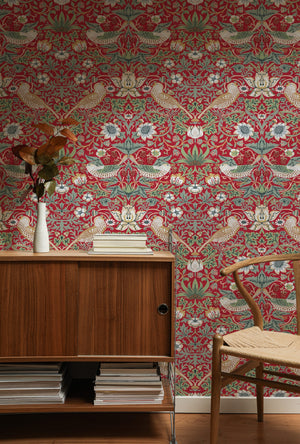
A handful of instincts run through all of it. The first is nature, watched closely: real plants, real birds, drawn from life instead of invented. Morris got Strawberry Thief from the actual thrushes robbing his fruit garden, and that habit of looking before drawing sits under everything.
The rest comes down to the making. Work it by hand, block-print the paper, joint the furniture, weave the cloth on a hand loom. Run your palm across an Arts and Crafts oak table and you feel real grain and the faint ridge of a chisel, never a sprayed-on fake. They had a phrase for it, truth to materials. Show the grain. Leave the hammer mark. Don't dress one thing up as another. It had to work, too, so a chair was for sitting in and a paper had to suit its wall rather than just shout. And beneath all of it ran a moral streak, a belief that good design made a worker's life better and pushed back on the grind of the factory. Plenty of these people, Morris loudest among them, were committed socialists.
What was the movement protesting against?
Cheap, dishonest, badly made factory goods, above all. Picture a Victorian dining chair: stamped tin painted up to pass for carved oak, ready to chip the first time you knocked it with your knee. The factories could turn that out by the ton now, and Morris and his circle found it both ugly and, in a real way, wrong. Fake was the enemy.
They hated the lives behind the goods just as much. Factory work was repetitive and joyless and barely paid, and the movement argued that seeing an object through from raw material to finish was simply a more human way to spend a day. That's the thread the V&A picks up when it says "Morris argued for the return to a system of manufacture based on small-scale workshops". And beyond the workbench they pushed back on the whole cluttered, dark, over-stuffed Victorian room, and on the gap between rich and poor that let it all stand.
Arts and Crafts versus Art Nouveau
People muddle these two constantly, so here's the clean split. Age first. Arts and Crafts is the elder, born in the 1860s and cresting through the 1880s and 1890s. Art Nouveau turned up in the 1890s and peaked in the early 1900s. Part of it grew out of Arts and Crafts, then wandered off on its own (children do).
The plants give it away. Morris drew a flower you could name, the way he got Strawberry Thief from real thrushes in his fruit garden. Art Nouveau takes that flower and pulls it into a long whiplash curve, until the botany matters less than the swoop.
The deeper gap is the one people forget. Morris and his circle cared fiercely about who made a thing and how, which was half the Arts and Crafts quarrel with the factories. Art Nouveau mostly didn't mind a machine, so long as the result looked striking.
Hang a Morris paper from 1885 next to an Art Nouveau one from 1895 and for a second they rhyme. Get closer. Morris drew what he saw, and the Art Nouveau paper restyled it. Quickest test we know.
How the movement ended
It didn't crash. It dissolved. Across the 1920s and 1930s its ideas bled into Art Nouveau, then Art Deco, then modernism, handing on truth to materials and honest function even as its own slow hand-work fell behind a faster, cheaper age. Hand-work cost too much. The World Wars broke the old workshop economy for good. By 1950 Arts and Crafts was something you studied, not something you joined.
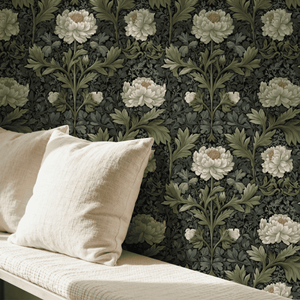
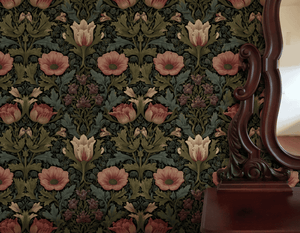
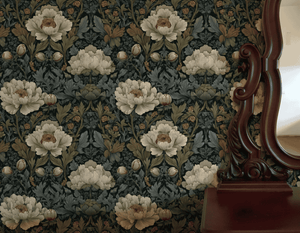
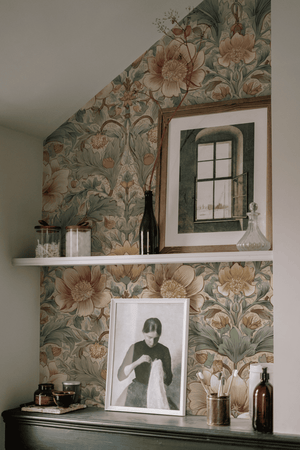
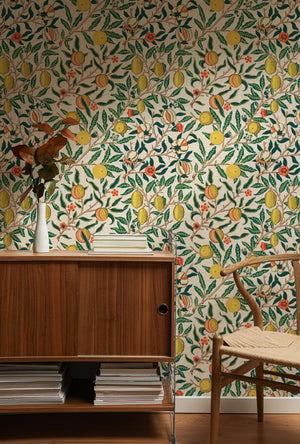
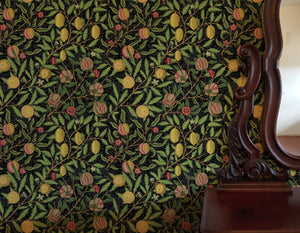
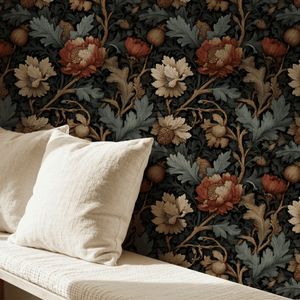
And then it wouldn't stay dead. Heritage Arts and Crafts patterns, with original William Morris designs at the front, are leading one of the strongest wallpaper markets in decades.
Legacy and social significance
Its biggest win is the one nobody notices, because it went all the way through. The movement made decorative art count. Before it, a wallpaper or a chair ranked well below a painting; after it, design earned museums, scholarship, and serious argument.
It reached past taste, too. The claim that craft work beat factory work for the person doing it fed straight into early British socialism, carried by Morris and Ashbee. Its principles rolled on into modernism, the Bauhaus, and the way design gets taught right now. Morris's conservation work survives most plainly of all: the Society for the Protection of Ancient Buildings, which he started in 1877, still shapes how Britain repairs a medieval church. Even the way we argue today over sustainable design and where our stuff is made is the same old Arts and Crafts case, wearing newer clothes.
Where the movement spread
It began in Britain and traveled easily. London was the hub, with Morris's firm and the Exhibition Society, and the Cotswolds and his Oxfordshire base at Kelmscott as quieter outposts. Then it jumped the Atlantic. America took to it hard from the 1890s, through Gustav Stickley's furniture, Elbert Hubbard's Roycroft community, and the early Prairie School houses of Frank Lloyd Wright.
Germany and Austria built their own versions, the Deutscher Werkbund and the Vienna Secession, and those fed almost directly into the Bauhaus and modernism. Scandinavia grew a quieter strain, all natural materials and plain function, and you can still feel it in Scandinavian design today.
Examples of Arts and Crafts architecture
Red House is where it starts, out in Bexleyheath, and the National Trust that looks after it records the place was "Designed by Philip Webb and completed in 1860". Plain local materials, and decoration made for the house instead of bought in. Everyone copied that.
Webb wasn't finished. In the early 1890s he built Standen House in West Sussex, one of the best-kept Arts and Crafts homes anywhere, and its rooms are still hung with original Morris papers and fabrics (go if you're ever nearby). The great American one is the Gamble House in Pasadena, built by Greene and Greene in 1908, where Arts and Crafts ideas meet a Japanese touch and the two get along so well you stop seeing the join.
Churches count too. Morris's firm left its mark in early stained glass, the windows at All Saints, Selsley, from 1862 among them.
Arts and Crafts Movement Questions
What was the Arts and Crafts movement?
A late-nineteenth-century design and social movement that argued for hand-crafted work, naturalistic pattern, traditional methods, and the value of well-made everyday objects. Britain had it first, in the 1860s. It peaked through the 1880s and 1890s and was still steering design in the 1920s, long after Morris had gone.
When did the Arts and Crafts movement begin?
In Britain in the 1860s, with roots in John Ruskin's 1853 essay "The Nature of Gothic." The label came last. Red House (1859 to 1860) and Morris's firm (1861) were the first working examples, and the name only arrived with the Arts and Crafts Exhibition Society's first show in 1888.
Who is the father of the Arts and Crafts movement?
William Morris is usually called the father of the movement as its practical leader, with John Ruskin regarded as its intellectual father. Ruskin supplied the ideas. It was Morris who turned them into real products, though, and he led the movement right up to his death in 1896.
How is Arts and Crafts different from Art Nouveau?
Arts and Crafts came first and drew its patterns from closely observed nature, while Art Nouveau emerged in the 1890s and abstracted nature into flowing, stylized curves. Keep one difference in your head and make it the machine: Arts and Crafts insisted on hand production, and Art Nouveau was content to be made by one.
Who is the most famous Arts and Crafts designer?
William Morris. Walk into a room papered in Strawberry Thief or Willow Bough and you're looking at his work. Same with Acanthus and Pimpernel. Trellis, too. More than 150 years on, his wallpapers and textiles are still the Arts and Crafts designs people ask for by name.
Is the Arts and Crafts style still popular?
Yes, very much so. Heritage Arts and Crafts patterns are easy to find on new walls again, William Morris originals above all. Not bad for an idea from the 1860s.


