


What Is Chintz?
Chintz is a glazed cotton printed or painted in several colors, most often with big flowers on a pale ground, and it started out as the hand-painted cotton cloth of India. English borrowed the name from the Hindi chint in the early 1600s. From the 1650s, chintz from India's Coromandel Coast was among the most sought-after cloth in Europe, popular enough that France banned it in 1686 and England followed in 1700. Printers spent decades trying to copy it. By the 1800s the word covered English printed florals too, and it's still what people call blowsy roses on curtains or floral wallpaper.

Unknown maker, Coromandel Coast, India, quilted palampore for the Dutch market, about 1720. Public domain, via The Metropolitan Museum of Art.
What is chintz fabric?
Chintz fabric is plain-woven cotton with a glazed, faintly shiny surface, usually printed with flowers in several colors on a light ground. That's close to Britannica's definition, and it hides a small surprise: the glaze defines it, not the flowers. A solid-color cotton counts as chintz if it's glazed. Leave the same print dull and it's cretonne.
The shine came two ways. Indian finishers burnished the dyed cloth with a shell or a similar tool, the V&A notes of a piece from Machilipatnam. The factory method applies a stiffener such as starch or glue, then runs the cloth through smooth, hot rollers that polish it by friction. Resin does that job now, and it's meant to be permanent.
Old glaze rarely is. On most surviving Indian pieces it has worn off, so in a museum you're mostly looking at bare dye.
Where does the word chintz come from?
The word comes from the Hindi chint (chīnṭ in Urdu), meaning spotted or speckled cloth, and English first wrote it chints, the plural, before settling on chintz. The older roots are argued over.
Sylvia Houghteling, writing for the Met in 2016, laid out both camps. One traces chīnt to the Sanskrit vichitra, a thing painted with a picture. The other goes to chītna, a verb for spotting or sprinkling, and that reading hands the credit to the dyer. We like the second one. Getting color to sink into cotton and stay bright was the hard part.
Samuel Pepys still felt he had to explain the word. On 5 September 1663 he went shopping in Cornhill, in London, and his diary says he "bought my wife a chintz, that is, a painted Indian calico." It was to line her new study. A gloss, in a private diary.
How was Indian chintz made?
Indian chintz was painted by hand onto cotton using mordants, metal salts that fix a dye and set its shade, and resists like wax, which keep the dye off whatever they cover. No press. Just a pen and a long run of dye baths.
The V&A owns eight unfinished samples from the Coromandel Coast, made around 1919, that stop the process at each stage. A charcoal stencil comes first. A painter with a kalam, a bamboo pen, lays down alum and iron mordants, and a bath of chay root, the local red dye, turns the alum lines red and the iron lines black. Then everything but the blue areas disappears under beeswax and goes into indigo. Wax off. Yellow over blue makes green. The cloth was washed and bleached between colors, and Houghteling notes the first bleach used lemon or lime and sheep's dung, a detail that never makes the gift-shop version.
Why the southeast coast? The V&A credits local chemistry, a lucky mix of minerals in the soil and water, and the Met adds that chay root grew in the calcium-rich soil of the river deltas there.
Gujarat, on the west coast, had other strengths. Its workshops resist-dyed and block-printed cotton for distant buyers long before the English or Dutch came, and Britannica notes that the oldest surviving fragments, from the 1400s, turned up at Fustat, near Cairo. Mochi embroiderers from Gujarat also stitched palampores in chintz's flowering-tree designs, in chain stitch so fine the V&A says a hanging looks printed until you get close.
Ideas traveled both ways. Indian painters filling European orders worked in motifs from English embroidery, and our guide to Jacobean style picks up the crewelwork side of that exchange.
Why did France and England ban chintz?
France and England banned chintz to protect their own textile trades, France in 1686 and England in 1700, after Indian cotton became popular enough to threaten home-grown silk and wool.
The East India companies built that market fast. England's got its charter in 1600, the Dutch one two years later, and at first, the V&A says, Indian cloth was just something to swap for spices in Indonesia. From the 1650s, chintz made for Europe was a prize commodity. It held its colors in the wash, without fading or running, and printers in Britain and France tried for decades to match it.
Two waves of bans followed. France's law held until 1759. England's 1700 act stopped the imports, and a 1721 act, pushed by petitions from wool country like East Anglia and Yorkshire's West Riding, banned the wearing of many kinds of cotton cloth outright.
Neither ban killed the taste. English printers could still print for export, so their skills kept improving legally, and the Dutch, with no ban at all, built their own printing trade in the late 1600s. Nobody outlaws a cloth nobody wants.


How did English printers copy chintz?
English printers copied chintz with carved woodblocks at first and engraved copper later, and by the early 1800s their own furniture chintzes, made for curtains and beds, were the finest printed furnishings money could buy.
Copper came by way of Ireland, where engraved-plate printing on cloth was developed in 1752; it gave fine detail, but in one color. Copper rollers were running in the north of England by 1790. They printed faster and cheaper, and output of printed cotton shot up through the 1800s.
The top work still came off blocks for a while. Bannister Hall, near Preston in Lancashire, founded about 1798, was the leading works for woodblock furniture chintzes. Richard Ovey, a Covent Garden linen-draper who supplied the Prince of Wales, commissioned designs from artists and sent them north to be printed. By the 1830s, though, rollers had largely taken over fashionable furnishings.

Bannister Hall printworks, Preston, printed furnishing cotton, about 1833. Public domain, via The Metropolitan Museum of Art.
Victorian chintz at its grandest looked like the V&A's False Principle no. 16, block-printed and glazed in Lancashire around 1850 and shown at the Great Exhibition of 1851. It was the most expensive, most popular kind of summer furnishing going. In 1852 Henry Cole put it in his "False Principles in Design" show at Marlborough House, faulting its "direct imitation of moss roses". His colleague Richard Redgrave added that lifelike flowers make no sense on cloth that hangs in folds.
We think Redgrave had the better argument. A rose shaded to look solid goes strange when a curtain bunches it in half.
Did William Morris make chintz?
In a sense, yes: William Morris's firm launched its printed fabrics in 1868 with copies of 1830s white-ground chintzes, and Morris later designed a pattern called Little Chintz (1876). Museums mostly catalog his work as printed cotton, though the William Morris Gallery describes its Wey as a cotton chintz printed by indigo discharge.
Small Stem ties him straight back to Bannister Hall. One of the first three designs his firm sold, it was a Bannister Hall print of the 1830s, reprinted for him with blocks rather than rollers, a rule he kept for life, the V&A says. What bothered him were the chemical dyes. In 1875 he began working with Thomas Wardle at his dye works in Leek, Staffordshire, to bring natural dyes back.
The real break came in 1881, at Merton Abbey, an old textile-printing works near Wimbledon. The River Wandle gave him soft water, and the site gave him room for huge indigo vats. He'd tried indigo discharge printing in 1875 and couldn't make it work until then.
Discharge printing runs backward. The whole cloth goes into the vat, comes out dark green and turns blue in the air. A bleaching agent is then block-printed wherever the design shouldn't be blue, and a wash clears those spots. Strawberry Thief, registered on 11 May 1883, was the first of these to add red (alizarin) and yellow (weld). That May, Morris told his daughter he'd spent much of a week at Merton watching over its first printing.
He went all in. Of the 19 patterns his firm registered between May 1882 and September 1885, 17 were designed for indigo discharge. Strawberry Thief, which now also comes as William Morris wallpaper, is one of his best-known designs, as the V&A puts it.

William Morris, Strawberry Thief, designed 1883, this length printed at Merton Abbey about 1936. Public domain (CC0), via The Cleveland Museum of Art.
Why does chintzy mean cheap?
Chintzy came to mean gaudy or cheap in 19th-century Britain; the word is first recorded in 1851, and the Met traces its tacky sense to the letters of George Eliot.
Nobody wrote down why it soured, so we won't pretend to know. The timing is suggestive, though. Rollers had made printed cotton cheaper and more plentiful than ever, and in 1852 Henry Cole was holding a chintz up as a bad example. Merriam-Webster adds a second meaning, stingy.
The cloth never went away. The V&A notes that Small Stem came back in the 20th century as floral chintz grew popular again, and was still sold in 1940. Then came John Fowler (1906-1977), whom Historic England ranks among the most influential interior decorators of the century. He worked from fragments of old textiles; the V&A has his design for a chintz drawn that way, roses in a wicker basket. With the American Nancy Lancaster, who bought the firm he worked for after the war, he codified what came to be called the English Country House Style. That's the world we have in mind when we hear country-house chintz.
What's the difference between chintz, calico, toile and cretonne?
Chintz is the glazed, many-colored one, and calico is the plain printed cotton it's usually made from; Britannica calls chintz, often, a highly glazed printed calico.
Calico takes its name from Calicut (now Kozhikode) in India, where it was made by the 11th century, if not earlier. It's plain-woven and printed with simple designs. Pepys's purchase was both at once, a chintz he called a painted calico.
Cretonne is heavier, with a dull finish, and goes on upholstery. The name is thought to come from Créton, a village in Normandy, and Britannica is blunt about the link: unglazed chintz is cretonne.
Toile? A different animal. It's a pictorial print, scenes rather than bouquets, named toile de Jouy after the factory Christophe Oberkampf opened at Jouy-en-Josas, near Paris, in 1760, the year after France lifted its ban. Our toile guide tells that story properly.
Tiny scattered flowers are another family again, covered in our guides to the ditsy pattern and to small dress-print florals.
How does a chintz pattern work as wallpaper?
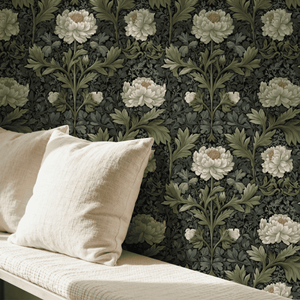
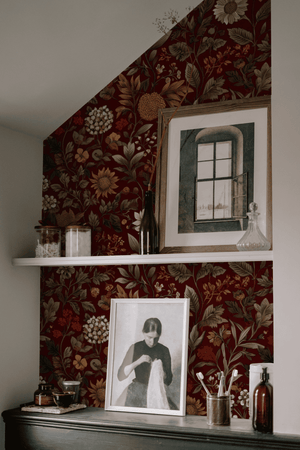
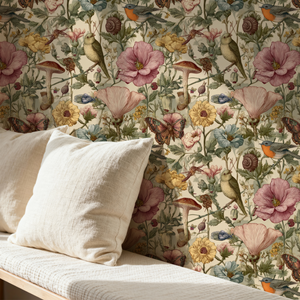
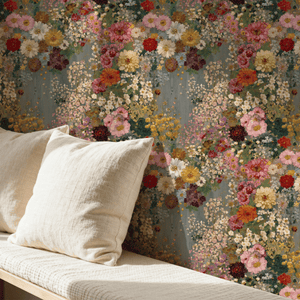
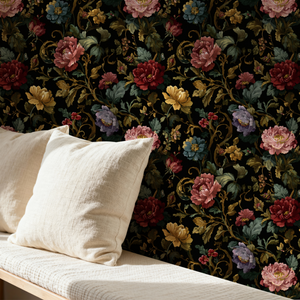
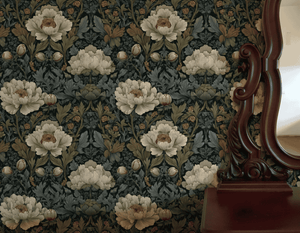
A chintz pattern works best as wallpaper when the flowers get room to repeat, across a full wall or a whole room, not squeezed into a strip between a door and a window.
Paper won't give you the glaze, and we wouldn't hunt for a glossy finish to fake it. Lean on the drawing and the color instead. Scale is what reads as chintz: roses the size of your palm say chintz from the doorway, and thumbnail-sized ones put you in ditsy territory.
Take a guest bedroom, 12 by 14 feet, with one window and the bed on the long wall. We'd paper all four walls in a big-bloom floral on a cream or white ground (the 1830s chintzes Morris's firm copied were white-ground, after all) and hang plain linen curtains. One loud pattern, one quiet one. Facing north? Go cream.
Big florals in that spirit run through our vintage wallpapers, peonies and bouquets mostly. Patterns have crossed between cloth and paper for a long time (Morris used his 1875 Marigold for both), and our history of wallpaper follows the paper side.
Chintz questions
Is chintz always floral?
No, chintz can be any glazed cotton, including a plain one in a single solid color. Flowers are what the European market wanted, the V&A says, and the association stuck.
What is a palampore?
A palampore is a large Indian chintz panel made as a bedcover or wall hanging, often painted with one great flowering tree. The quilted one at the top of this page, made for the Dutch market around 1720, belongs to the Met.
Is chintz the same as kalamkari?
Largely, yes, since the Met describes the same mordant-and-resist painting as kalamkari in India and chintz in the West. Kalamkari means pen-worked. Later Machilipatnam pieces brought in block printing, though.
Where can you see old chintz?
Two of the best places are the V&A in London and the Met in New York, which both publish photographs of their Indian and English chintz online. One set of late-1600s chintz panels from Ashburnham Place in Sussex is now split among four museums on three continents.
Does the glaze on chintz last?
Chintz glaze rarely survives on old pieces. The V&A says the burnished shine on Indian chintz has usually worn away, while modern resin glazes are made to be permanent.


