


Who Was Emery Walker?
Sir Emery Walker (1851-1933) was an English engraver, printer, typographer, and social activist, a major figure in the British Arts and Crafts Movement and the private press movement. Walker was born in Paddington, London, in April 1851 and died at 7 Hammersmith Terrace, his Hammersmith home, in July 1933, age 82. He played a central role in the revival of fine printing in late Victorian and Edwardian Britain, co-founding the Doves Press with Thomas James Cobden-Sanderson in 1900 and providing crucial advice and technical expertise to William Morris's Kelmscott Press (founded 1891). His close friendship with William Morris from about 1883-84 connected him to the broader Pre-Raphaelite, Arts and Crafts, and socialist circles in late Victorian Hammersmith. Walker also worked through his company Walker and Boutall (later Walker and Cockerell) on photographic and typographic engraving, helped found the Arts and Crafts Exhibition Society in 1888, and worked with the Society for the Protection of Ancient Buildings (SPAB) alongside Morris. The Emery Walker Trust preserves his home at 7 Hammersmith Terrace, one of the most complete Arts and Crafts interiors in Britain.

Page from the Kelmscott Chaucer, 1896. Public domain, via Wikimedia Commons.
This guide covers who Emery Walker was, his early life and engraving career, his friendship with William Morris, his role in the Kelmscott Press and Doves Press, his home at 7 Hammersmith Terrace and the Emery Walker Trust, and his lasting influence on the private press movement.
Who was Sir Emery Walker?
Emery Walker was an English engraver, printer, typographer, and social activist born in London in 1851 and died at Hammersmith in 1933. In 1930 he was knighted for what he'd done for printing and design, and from then on he was Sir Emery Walker. Not bad for a boy who'd left school at thirteen.
Most of what he knew, he taught himself. His father lost his sight and couldn't go on working, so the schooling stopped and the earning started, beginning with several miserable years as an apprentice draper. In 1873, at twenty-two, he got out and joined the Chiswick-based Typographic Etching Company. It was a good place to land. The firm was developing cutting-edge ways to turn works of art and photographs into book illustrations (it helped revolutionize Victorian book production, in fact), and Walker learned the trade from the technical end.
Hammersmith came next, and with it William Morris. Walker moved to that corner of west London in 1879 and found himself living near Kelmscott House, Morris's London home on the Upper Mall from 1878, and the friendship followed in about 1883-84. Being neighbors helped. What held them together, though, was printing and design, and a shared socialism. From then on they were close friends who also did their thinking together.
Morris's Kelmscott Press (founded 1891) ran on Walker's advice and technical expertise, and the famous Kelmscott Chaucer of 1896 came off its presses. The idea had started with Walker too. At the first Arts and Crafts Exhibition Society show in 1888 he gave a lecture on "Letterpress Printing and Illustration," and that talk directly inspired Morris to start a press of his own. You'll often see the same lecture cited as the catalyst for the whole private press movement of the 1890s.
Morris died in 1896. In 1900 Emery Walker went into partnership with the bookbinder Thomas James Cobden-Sanderson, and together they founded the Doves Press, which ran until 1916 and printed some of the most beautifully designed books of the early twentieth century. The Doves Press Bible (1903-1905) is the celebrated one. Shakespeare and Goethe were on the list as well, with other major literary figures.
From 1903 until his death in 1933 he lived at 7 Hammersmith Terrace, and the house became a center of Arts and Crafts life in Hammersmith, intellectual and social. His daughter Dorothy Walker stayed on after he died. Today the Emery Walker Trust keeps it as one of the most complete Arts and Crafts interiors in Britain (and yes, you can visit).
What was Emery Walker's early life?
Emery Walker was born in April 1851 in Paddington, London. His father was a coach builder, and the family was lower-middle-class, getting by in modest circumstances. Emery had a basic education in London. It didn't last. At thirteen he was forced to leave school, because his father's vision was going and the household needed whatever the boy could earn.
What followed was several miserable years as an apprentice draper, starting in his mid-teens. The work suited neither his interests nor his temperament, but it paid, and the family needed the money. He kept reading in his spare time. Widely, too, building up the kind of intellectual interests his limited formal education had never given him.
In 1873, age twenty-two, he finally left the drapery for the Typographic Etching Company in Chiswick. Here was a firm working at the front edge of its trade. It was finding new ways to reproduce works of art and photographs as book illustrations, using process engraving (a mechanical, photographic method of reproduction) and other new technologies of the moment, and the years there gave Walker his technical grounding in modern book production and illustration.
By 1886 he was running his own engraving and reproduction business. Walker and Boutall was a partnership with Walter Boutall, a fellow engraver, and the firm made photographic and typographic engravings for book illustration and publishing. Commercial reproduction work came in as well. The business did well, and that's the quiet fact behind most of this guide: it gave Walker the financial security to follow his printing and Arts and Crafts interests.
Later the firm became Walker and Cockerell, a partnership with Sir Sydney Carlyle Cockerell, who had been Morris's secretary. Under either name it stayed his commercial base for the rest of his career, and the income it brought in let him take part in the Arts and Crafts and private press movements.
Before any of the Morris years, there was a wedding. Mary Grace Jones became his wife in 1877, and their one daughter, Dorothy Walker, was born in 1878. Keep Dorothy in mind, since she's the one who later inherited the house at 7 Hammersmith Terrace.
How did Emery Walker work with William Morris?
Emery Walker and William Morris became neighbors in 1879 when Walker moved to Hammersmith and found himself living near Morris's London home Kelmscott House on the Upper Mall. Living a few houses apart helped, though the friendship itself dates from about 1883-84. Printing and design kept them talking. So did socialism, and the Arts and Crafts movement taking shape around them.
By the mid-1880s they were close friends and thinking partners. Politics was a big part of it. Morris was active in the socialist movement through the Social Democratic Federation and later the Socialist League, while Walker worked through similar reform organizations. They cared about the same things in design, too, printing and book illustration first among them, and they moved in the same circles in Hammersmith and in London's cultural life.
The Kelmscott Press is where Walker's hand shows most clearly in Morris's work. In November 1888 he gave his lecture on "Letterpress Printing and Illustration" at the first exhibition of the Arts and Crafts Exhibition Society in London. He showed examples of fine printing from earlier periods and made the case for bringing careful design and craft back to book production. Morris attended. He came away directly inspired, and seriously considering a private press of his own.
He founded the Kelmscott Press in 1891, and Walker kept advising. Type design was part of that. Paper selection and ink came into it as well. So did printing technique, and the rest of the practical side of fine-press production. Walker was never a formal partner (the press was Morris's own enterprise). Still, all through its operating years, 1891 to 1898, he was the advisor and supporter Morris counted on.
Across those years the press produced 53 limited-edition illustrated books. Everyone knows the Kelmscott Chaucer (1896, with 87 illustrations by Edward Burne-Jones). Morris's own romances and other writings came off the same presses, alongside many other major works. The Kelmscott Press established the modern private press movement, and fine-press printing has carried its stamp for over a century.
Books weren't the only thing they did together. The Society for the Protection of Ancient Buildings (SPAB) was founded by Morris in 1877, and Walker joined it later. The two of them were active in socialist political organizations as well. And there was the Arts and Crafts Exhibition Society, which Walker had helped found in 1888, eight years before Morris's death.
Morris's health declined from 1894, and the friendship held through those last years. Walker came regularly to Kelmscott House in that time and helped support him through his final illness. When Morris died in October 1896, Walker lost a close friend and collaborator of more than a decade.
What was the Doves Press?
The Doves Press was a fine-press private printing company founded by Emery Walker and Thomas James Cobden-Sanderson in 1900 at Hammersmith, London. It ran from 1900 to 1916. In those sixteen years it printed some of the most beautifully designed books of the early twentieth century.
Cobden-Sanderson (1840-1922) was a master bookbinder, and in 1893 he'd founded the Doves Bindery in Hammersmith. His bindings were made to the highest standard, and he often bound books for other private presses, the Kelmscott Press among them. Cobden-Sanderson and Walker had been friends, and Arts and Crafts collaborators, for years before they started the Doves Press together.
So the Doves Press paired Cobden-Sanderson's skill as a binder with Walker's as a typographer. They designed and made their own typeface, the Doves Roman, which Walker based on fifteenth-century Venetian models. The paper was hand-made and the type was hand-set. Everything aimed at the highest level of craft and design (none of which is fast work).
The press worked out of 1 Hammersmith Terrace. Over its 16 years it produced approximately 50 books, every one a limited edition and usually somewhere from 200 to 500 copies. Goethe was on the list, and Shakespeare. Milton and Browning were there too, with other major literary figures.
Ask for the famous one and you'll hear about the Doves Press Bible (1903-1905), a five-volume King James Bible in elegant type with restrained decoration. It's widely considered one of the most beautiful printed books of the twentieth century and still serves as a major reference for fine-press design. Set it next to the Kelmscott Chaucer page at the top of this guide and you can see two friends pulling in opposite directions. Morris gives you a woodcut border and dense black letter type. The Doves Press Bible gives you Walker's Doves Roman and very little else. Our pick is the Doves page, though we wouldn't argue too hard with anyone who prefers the Chaucer.
It ended in a fight. In 1916 the two partners disagreed over what should become of the press's matrices and punches once it closed, and Cobden-Sanderson settled it on his own, in a controversial act that's hard to believe even now. Secretly, over a series of nights in 1916, he threw the entire stock of Doves Press type, along with its matrices and punches into the Thames from Hammersmith Bridge. Those were the only copies of the Doves Roman type. After that the Doves Press closed for good.
Some of it has come back. In 2013 the British designer Robert Green partially reconstructed the Doves Roman, digitizing it for modern computer use from photographs and surviving printed examples. And since 2014, pieces of the original Doves type have been recovered from the Thames riverbed. Together, the recovery and the reconstruction make up one of the major late twentieth and twenty-first-century projects in fine-press printing history.
What was 7 Hammersmith Terrace?
7 Hammersmith Terrace is the house at 7 Hammersmith Terrace, Hammersmith, London (a Georgian terrace on the north bank of the River Thames) that Emery Walker occupied from 1903 until his death in 1933. The Emery Walker Trust preserves it now as one of the most complete Arts and Crafts interiors in Britain, and it's open to visitors.
Number 7 wasn't his first house on the terrace. Before 1903 he'd lived at number 3, in the same Georgian row overlooking the Thames. The neighborhood was a major Arts and Crafts community in its own right. Hammersmith Terrace belonged to it, and so did Hammersmith Mall and the Upper Mall, where William Morris had lived at Kelmscott House just a few houses away. Plenty of others from the Arts and Crafts circle lived close by or came visiting often.
The household itself was small. Emery and Mary Grace lived there with their daughter Dorothy, plus a housekeeper. Visitors were another matter. Members of the Morris family came regularly, and so did Pre-Raphaelite figures. Socialists and printers turned up too, along with plenty of others from the Arts and Crafts circle, which is how the house became a center of intellectual and social life.
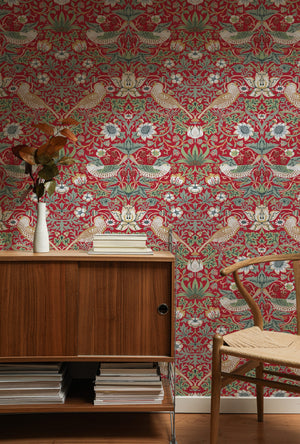
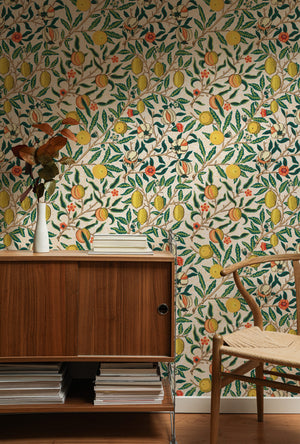
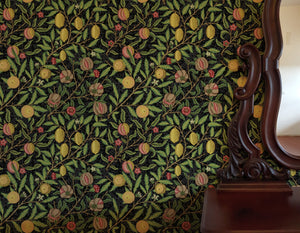
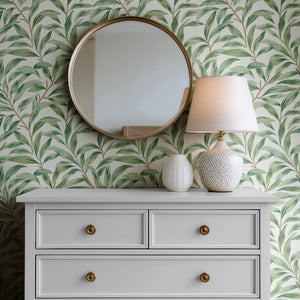
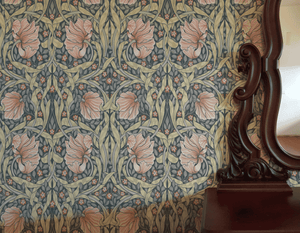
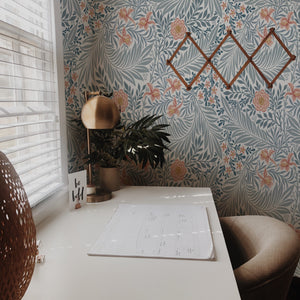
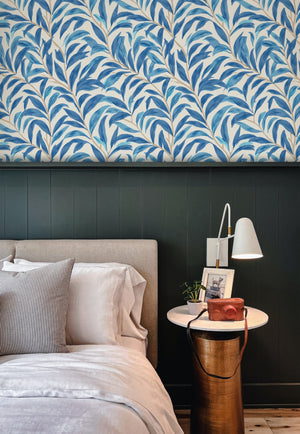
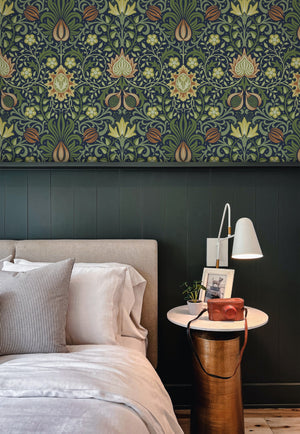
Inside, it's Arts and Crafts decoration from wall to wall. William Morris designs cover the walls, Bird and Anemone and Willow Boughs among them. Acanthus is there too. So is Bird and Pomegranate, and many others. Furniture from Morris's firm fills the rooms, along with its textiles and decorative objects, and Pre-Raphaelite paintings by Edward Burne-Jones and others hang on the walls. The family's own books and prints add to the mix. If you've ever wondered how Willow Boughs looks behind real furniture, with a family's books and paintings around it, this is the house we'd send you to.
After Emery died in 1933, Dorothy Walker lived on in the house until her own death in 1963, and she kept it exactly as her father had left it. The original Morris wallpapers stayed. So did the furniture from Morris's firm and the Pre-Raphaelite paintings, and his personal possessions stayed where they were. Over those years the house became a time capsule of late Victorian and Edwardian Arts and Crafts taste.
Dorothy died in 1963 and the house passed to Elizabeth de Haas, Dorothy's companion. She kept preserving it until she died in 1999. In 1999 the house and its contents went to the Emery Walker Trust, which had been established to keep the property as a museum.
In 2005 the Emery Walker Trust opened the house to the public for guided tours. Take one and you get something no book can give you: a direct look at how an Arts and Crafts household actually lived, in one of the most complete and authentic Arts and Crafts interiors in Britain. The wallpapers are original. The furniture came from Morris's firm, and the paintings and the family's own decoration are still in place around it, which is why the house is such a unique resource for understanding the Arts and Crafts Movement.
How did Walker influence the private press movement?
Emery Walker influenced the private press movement through his 1888 lecture on "Letterpress Printing and Illustration" (which directly inspired William Morris to found the Kelmscott Press in 1891), his technical advice to Morris during the Kelmscott Press years, his co-founding of the Doves Press in 1900, his design of the Doves Roman type, and his broader influence on twentieth-century fine-press printing.
It all goes back to the 1888 lecture, the foundational moment of the modern private press movement. Walker gave it at the first exhibition of the Arts and Crafts Exhibition Society in London, a society he'd helped found earlier that year. He brought examples of fine printing from earlier periods, especially fifteenth-century Venetian typography, and argued for reviving careful design and craft in the making of books. One of the people listening was William Morris. By 1891 he had the Kelmscott Press.
The Kelmscott Press (1891-1898) then set the pattern. The Doves Press (1900-1916) built on its example. So did the Eragny Press (1894-1914) and the Ashendene Press (1895-1935), and the Vale Press (1896-1904) after them, along with other private presses of the late nineteenth and early twentieth centuries. Walker was directly involved in two of them, the Kelmscott Press and the Doves Press. The others felt him at one remove, through his advice and design work.
Then there's the type. The Doves Roman that Walker designed for the Doves Press became one of the most admired private press typefaces, modeled on fifteenth-century Venetian typography and especially on Nicolas Jenson's 1470 Venetian Roman type. It carried his principles of careful traditional design, and later twentieth-century type design took from the Doves Roman right up until 1916, when the physical matrices were destroyed.
His reach was unusually wide. He had the technical expertise and the design vision, and he never stopped engaging with the private press world, which is what gave him that reach in twentieth-century fine-press printing. The major private presses of that century drew on the Kelmscott Press and Doves Press examples he'd helped establish. The Golden Cockerel Press was one, the Nonesuch Press another. The Curwen Press too, and many more.
The knighthood arrived in 1930. Walker became Sir Emery Walker in recognition of his contributions to printing and design, and the honor reflected his standing as one of the most important figures in twentieth-century British printing history. He went on advising on printing and design until his death in 1933.
What is Emery Walker known for?
Emery Walker is known for his crucial role in the modern revival of fine printing, his 1888 lecture that inspired William Morris to found the Kelmscott Press, his technical and design advice during the Kelmscott Press years (1891-1898), his co-founding of the Doves Press with Thomas James Cobden-Sanderson in 1900, his design of the Doves Roman typeface, his close friendship with William Morris and his place in the broader Hammersmith Arts and Crafts circle, his work at the Society for the Protection of Ancient Buildings (SPAB), his founding role in the Arts and Crafts Exhibition Society (1888), and his preserved home at 7 Hammersmith Terrace now open to the public through the Emery Walker Trust.
In private press history he's one of the most important figures in the modern revival of fine printing, and the chain is easy to follow. His 1888 lecture set off the Kelmscott Press. The Kelmscott Press, in turn, set off the private press movement. Then his own Doves Press (1900-1916) made some of the most beautifully designed books of the twentieth century, and his Doves Roman type shaped typographic design for decades.
For the Arts and Crafts side of the story, Hammersmith is the place to look. Walker was a central figure in the Arts and Crafts community there, and his friendship with William Morris from about 1883-84 linked him to the Pre-Raphaelite and Arts and Crafts circles of late Victorian Hammersmith (and to its socialists). Helping found the Arts and Crafts Exhibition Society in 1888 was his part in giving the movement public visibility.
Then there's the house. Because the Emery Walker Trust has preserved 7 Hammersmith Terrace as one of the most complete surviving Arts and Crafts interiors in Britain, visitors today can see directly how an Arts and Crafts household actually lived. Original Morris wallpapers and furniture from Morris's firm are still there. So are the Pre-Raphaelite paintings and the family's own Arts and Crafts decoration, and together they make the house a unique resource.
We'd argue the technical side deserves more credit than it gets. Engraving and photographic reproduction were his first trade. Type design and book production came later, and between them his expertise touched late Victorian and early twentieth-century printing at many points. The commercial work at Walker and Cockerell paid for the artistic activities.
Politics ran through all of it. Walker took part in the socialist movement of late Victorian Britain, beside William Morris and other socialist Arts and Crafts figures, and he treated printing and design as serious cultural work because of it. Political work, too.
What was the Arts and Crafts Movement?
The Arts and Crafts Movement was a British design and decorative arts movement of the late nineteenth and early twentieth centuries, led by William Morris and his circle. Its argument was simple enough to fit on a banner. Hand-craft production, the movement said, could make better goods than mass industrial manufacture, and better lives for working people as well, which is how a love of traditional craftsmanship ended up tied to social and political reform.
Its ideas came first from John Ruskin, especially "Unto This Last" of 1860 and his chapter "The Nature of Gothic" in "The Stones of Venice" of 1853. The practice came from William Morris and Morris's firm (founded 1861). The Pre-Raphaelite Brotherhood (founded 1848) was an earlier, related movement, and many of its members overlapped with the Arts and Crafts circle.
Morris was the central figure. Around him were Edward Burne-Jones, painter and designer, and the architect Philip Webb. Ford Madox Brown was a painter. May Morris, William Morris's daughter, was an embroiderer and designer, and Walter Crane an illustrator and designer. Then came Charles Robert Ashbee (designer and architect) and the ceramic artist William De Morgan, and Emery Walker the engraver and printer, with many others.
Wallpaper is where we'd start, naturally, but the Arts and Crafts movement did major work across many decorative arts. Textiles and furniture, for two. Stained glass and metalwork belonged to it, and so did ceramic tile. Jewelry and embroidery too, and book design, which is where Walker comes in. Its major institutions included Morris's firm and the Guild and School of Handicraft (Ashbee's organization). The Century Guild was another, and the Birmingham Guild of Handicraft, with many more.
Abroad, Arts and Crafts ideas influenced the Wiener Werkstätte in Vienna. The American Arts and Crafts Movement took from it. So did Art Nouveau in continental Europe, and through those the movement fed into the development of modernist design in the early twentieth century. Our Arts and Crafts Movement guide covers the movement in detail.
When did Emery Walker die?
Sir Emery Walker died at 7 Hammersmith Terrace, his home in Hammersmith, London, on July 22, 1933, at age 82. Three years earlier, in 1930, he'd been knighted for his contributions to printing and design.
His funeral took place in Hammersmith, and people from the Arts and Crafts world and the printing trade came. Dorothy Walker stayed on at 7 Hammersmith Terrace, keeping up the family home in his memory.
Then came the Emery Walker Trust, set up to preserve the house at 7 Hammersmith Terrace and the wider Walker legacy. It opened the house to the public for guided tours in 2005, after extensive restoration work.
As for his reputation, private press scholarship has kept recognizing his place in the modern revival of fine printing ever since. The Kelmscott Press traces back to his 1888 lecture. He co-founded the Doves Press with Cobden-Sanderson in 1900. The Arts and Crafts Exhibition Society too, back in 1888, and he had a hand in other Arts and Crafts institutions besides. That's enough to make him a major figure in late Victorian and Edwardian British cultural history.
Interest in him picked up again with the 2013-2015 recovery of the Doves Press typeface. It happened two ways, through Robert Green's digital reconstruction and through the physical recovery of pieces of the original type from the Thames riverbed. Walker's Doves Roman is available for modern computer use now, and people still admire it for its design quality. If you only ever look at one thing he made, we'd make it that typeface.
Emery Walker questions
Who was Emery Walker?
Sir Emery Walker (1851-1933) was an English engraver, printer, typographer, and social activist, a major figure in the British Arts and Crafts Movement and the private press movement. Most of that life played out among the Arts and Crafts crowd in Hammersmith, a few houses from William Morris.
How did Emery Walker influence William Morris?
Walker influenced William Morris most directly through his 1888 lecture on "Letterpress Printing and Illustration" at the first Arts and Crafts Exhibition Society exhibition, which directly inspired Morris to found the Kelmscott Press in 1891. He never became a formal partner in the Kelmscott Press, mind you, just the advisor Morris relied on until 1898.
What was the Doves Press?
The Doves Press was a fine-press private printing company founded by Emery Walker and Thomas James Cobden-Sanderson in 1900 at Hammersmith, London. About 50 books in 16 years, and the five-volume Doves Press Bible is the one people still talk about.
What is the Emery Walker Trust?
The Emery Walker Trust is a charitable trust that preserves the home of Sir Emery Walker at 7 Hammersmith Terrace, Hammersmith, London. It took over the house in 1999 and opened it for guided tours in 2005.
What is 7 Hammersmith Terrace?
7 Hammersmith Terrace is the Georgian terrace house at 7 Hammersmith Terrace, Hammersmith, London, where Sir Emery Walker lived from 1903 until his death in 1933. Curious how Willow Boughs looks in a room people actually lived in? The Emery Walker Trust will show you.
Who was Thomas James Cobden-Sanderson?
Thomas James Cobden-Sanderson (1840-1922) was a master bookbinder who founded the Doves Bindery in Hammersmith in 1893 and co-founded the Doves Press with Emery Walker in 1900. He's also the man who, in 1916, threw the Doves Press matrices and punches off Hammersmith Bridge.
What was the Arts and Crafts Exhibition Society?
The Arts and Crafts Exhibition Society was founded in 1888 by Emery Walker, Walter Crane, and other Arts and Crafts figures as a venue for exhibiting Arts and Crafts design and craft work to the broader public. Its first show, in November 1888, is where Walker gave the lecture that started Morris on the Kelmscott Press.
When did Sir Emery Walker die?
Sir Emery Walker died at his home 7 Hammersmith Terrace in Hammersmith, London, on July 22, 1933, at age 82. A long life, then, with the knighthood (1930) arriving near the end of it.


