


What Is A Quatrefoil?
A quatrefoil is, at its simplest, four overlapping circles. Draw four of the same size so they cross, trace the outer edge, and you get the four-lobed, flower-like shape with notched corners that defines it. Some of its best-known early forms come from Islamic art and architecture, and it then became a signature of Gothic and Renaissance building across Europe from the twelfth to seventeenth centuries, turning up in tracery, stained glass, stonework, heraldry, and decorative arts. The motif is still going strong in 2026 wallpaper, fabric, jewelry, and architectural detail.

Below we get into what it symbolizes, how it differs from a clover or a trefoil, its history and Christian meaning, where it shows up, and how designers use it now.
What is a quatrefoil?
It is a decorative element formed by the outline of four partially overlapping circles of equal diameter. A medieval mason needed nothing fancier than a compass to lay one out. Each circle cuts across the two beside it, and where neighbors meet they leave four small pointed gaps. Those gaps do the work. They pinch the outline into a stylized four-petal flower (a four-leaf clover, to some eyes). The lobes sit at the cardinal points, two up and down and two side to side. All one size. Nothing tips.
A glazier could set the panel a quarter turn off, 90 degrees, and nobody down in the nave would ever spot it. Geometers have a name for that, fourfold rotational symmetry. It mirrors as well. Cut one out of paper and fold it across the middle, and the halves land right on each other. Fold it top to bottom and they do it again. Corner to corner on either diagonal, same thing.
Plain or barbed, mostly. The plain kind is the four circles and nothing more. The barbed kind is fussier, with a sharp thorn-like point pushed out of every notch, and Gothic tracery is crowded with it (carved stone too, once you start noticing).
The relatives come off the same compass. Take a lobe away and it's a trefoil. Add one for the five-lobed cinquefoil, and past that sit the sexfoil at six and the octofoil at eight. Europe kept choosing four, though. Why? Our theory is that four just looks finished, where three feels a bit spare and five a bit busy.
Finding one takes no effort. Walk into an old church and start up in the tracery. Then the stained glass. Then drop your eyes to the carved stone around the doors. Heralds put it on coats of arms. You'll see it on furniture as well, and textile and jewelry makers have leaned on it for ages. Wallpaper carries a lot of it, which is our excuse for caring. Very few single shapes in the European tradition have lasted this long.
What does a quatrefoil symbolize?
Its meaning has shifted across cultures and centuries. Islamic builders set the four-lobed rosette into mosques and palaces, and there it had readings of its own, tied to cosmic order and to the four directions. Medieval church decorators got more specific. They gave one lobe to each gospel and its writer, and before long a quatrefoil on a church wall was simply shorthand for the gospels.
Four was already a loaded number, so the fit came easily. A compass has four cardinal directions. A year has four seasons. The classical elements came in fours, and the cardinal virtues did too. Christian or not, a shape cut into four equal parts slotted right in.
Heralds pulled it a different way. On a coat of arms it becomes a stylized flower, often a primrose. That brings along the usual flower meanings (growth, virtue), plus whatever a particular family or institution decided it ought to say.
Luck came last. The outline looks so much like a four-leaf clover that folk belief hung luck and protection on it, though only once the Christian and architectural meanings had settled. So the lucky-charm reading, the one most people meet first, is really the latecomer. Which we find a bit funny.
What does the quatrefoil symbolize in Christianity?
The core Christian meaning is the four gospels and their authors, the four lobes standing for Matthew, Mark, Luke, and John. Every evangelist has a traditional symbol of his own, too. Matthew's is a man or an angel and Mark's is a lion. Luke has an ox. John has an eagle, and in church decoration the lobes sometimes hold those figures or creatures, so you're not left guessing.
Other readings grew up alongside the gospels. One is the cardinal virtues, justice and prudence along with fortitude and temperance. Another is the four corners of the cross, with the divine and the earthly meeting where its arms intersect. The cross is the reading we find more convincing, honestly.
Gothic cathedral work is where you'll see the symbolism most clearly. Notre-Dame in Paris has it in the tracery and around the doors. Our favorite example is in Florence, though, on the Baptistry, where the reliefs sit inside quatrefoil frames. There the shape stops being the picture and becomes the frame. Those two are only the famous ones.
Then came the Reformation. Protestant churches pared their decoration back, and from then on the religious association faded as a primary meaning while secular use took over. It's still the deepest historical layer the quatrefoil has, though.
What is the difference between a clover and a quatrefoil?
They look alike but differ in form and origin. Across a room both read as a four-part rosette. Walk closer. The clover is a living plant, a rare variation of white clover (Trifolium repens) that puts out four leaves where it usually grows three. Look at those leaves. Each is heart-shaped and separate, and they only touch at a central point.
Nobody grew a quatrefoil. Somebody drew it, four overlapping circles on a page or a slab of stone, and the lobes are simply what those circles leave behind. Clean arcs on every edge. No clover pulled out of a lawn is ever that regular. Botany on one side, drafting on the other, and that's how we keep them straight.

What is the difference between a quatrefoil and a trefoil?
The count. A quatrefoil has four lobes and a trefoil has three. You build both the same way, from overlapping circles of equal size, except the trefoil spaces its three at 120-degree angles around a center, which gives it threefold symmetry and three rounded lobes. It's nearly as common, too. Only the four-lobed version turns up more often in European decoration. Christian tradition gave the trefoil a meaning of its own, most often the Holy Trinity (the three persons in one God). Add one circle, then, and you've gone from the Trinity to the gospels. That's a lot of theology riding on a compass.
What is the history of the quatrefoil?
Its history runs across several thousand years and many cultures, partly because the four-overlapping-circles construction is so simple and pleasing that it appeared independently in different places. Anyone with a compass and an idle afternoon could stumble onto it. Some of the best-known early forms, though, come from Islamic art of the early medieval period. That's where geometric decoration worked out the whole foil family. It went into mosque tracery and into mashrabiya lattice windows. It was laid into tile, too. One common view is that the Islamic world was one of the routes by which the quatrefoil got into European decoration.
Europe took to it from the twelfth century on, when it became a signature of Gothic. Builders everywhere from France and England over to Germany and Italy threaded it through cathedral tracery and stained glass. They carved it into stone as well. Renaissance ornament then carried it on into the seventeenth century.
In the nineteenth century the Gothic Revival renewed it all over again. Augustus Pugin and his contemporaries put it on church furnishings and tiles. Their wallpapers and metalwork got it too. That's how a motif from medieval stone walked into Victorian interiors, and then on into the present.
Where is the quatrefoil used today?
It runs across architecture, decorative arts, fashion, jewelry, and interiors, kept alive by that mix of geometric simplicity and deep historical association. Jewelers might be the surprise. They hang it as a pendant that looks classic without trying (and, thanks to the clover, quietly lucky), and they work it into brooches and earrings. Still a favorite there.
Architects haven't let go of it either. Restore an old church, or put up a new one in Gothic Revival or traditional style, and it goes straight back into the tracery and the stained glass. Carvers still cut it in stone and wood. Metalworkers too. Indoors it's on wallpaper and fabric, and tile setters and fretwork makers use it, very often as a trellis-like field with each shape linked to the next right across the wall. That's our favorite version. Orderly from the sofa, a little medieval up close.
How is the quatrefoil used as a decorative pattern?
It works two main ways. The first is one shape on its own, the Florence Baptistry trick from earlier, where the quatrefoil is the frame. A glazier fits a whole stained glass scene inside the four lobes. A herald sets it on a coat of arms as a charge. Jewelers hang it from a chain, or make a brooch of it. Repeat it, though, and the character changes completely. Get the spacing right and the shapes tessellate into rows, hooked together or just sitting side by side.
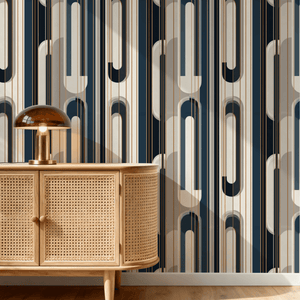
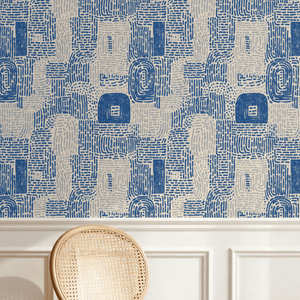
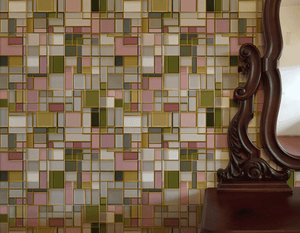
Wallpaper and fabric designers mostly land on one of two layouts. Medallions come first. Each quatrefoil floats by itself, and the repeat drops in the next one at a set interval all the way across the field. The interlocking lattice joins the lobes up instead, so the wall reads as a classic trellis. We'd hang the lattice in most rooms. Medallions drift toward polka dots (fun, sure, just harder to live with).
Scale sets the mood after that. Take the wall behind a sofa. Paper it in big quatrefoils, the sort you could count from the doorway, and it's a bold statement wall. Small ones on that same wall go quiet. They settle into a refined all-over texture, and from the sofa you stop seeing separate shapes at all. Same wall, same motif. Different room.
Quatrefoil questions
What is the significance of the number four in a quatrefoil?
Four ties the shape to the gospels, the cardinal directions, the classical elements, the seasons, and the cardinal virtues, which is part of why it appears so widely across both religious and secular decoration. And luck? That got tacked on much later, borrowed from the four-leaf clover, though it's the meaning most people reach for now.
Is the quatrefoil design specific to any particular period?
No. Islamic builders had it in tile and tracery early on. Gothic and Renaissance masons took it to its peak between the twelfth and seventeenth centuries, and then Pugin's generation dusted it off in the 1800s. It's on wallpaper in 2026, so if there's an end date, we haven't hit it.
What is barbed quatrefoil?
A more elaborate version with sharpened thorn-like points added at each notch between the lobes. Gothic tracery panels are full of them, and so is carved stonework. Next time a church window looks faintly spiky to you, that's why.
Where can the quatrefoil motif be found?
In church tracery and stained glass, carved stone, heraldry, furniture, textiles, jewelry, and wallpaper. Our advice is to start with an old church (take binoculars for the high windows). For your own walls, the geometric and trellis-style designs at William Morris Wallpaper Co are worth a browse.


