


What Is Fleur-de-Lis As A Decorative Motif?
The fleur-de-lis, also spelled fleur-de-lys and French for "flower of the lily," is a stylized lily or iris: three petals bound together at the base by a horizontal band. It has worked as both decoration and heraldic symbol across European art, architecture, and design since at least the 12th century. Most people know it as the badge of the French monarchy, where it sat on the royal coat of arms for nearly six centuries, but it also belongs to the Virgin Mary in Christian art, the three petals sometimes read as the Holy Trinity and the flower as Marian purity, and to King Clovis of the Franks, the first Christian Frankish king, traditionally credited with using it first. It is still everywhere in 2026: heraldry, religious art, decorative arts, fashion, jewelry, and contemporary design.

What is a fleur-de-lis?
It is a stylized lily or iris shown with three petals tied at the base by a horizontal band. Draw one by hand and you learn the order fast. The petals usually stand upright, so the middle one goes in first, tall and dead straight. Its two neighbors bow outward and curl back down, a mirror pair. The band comes last. It wraps the base and pulls all three into one flower (skip it and you've drawn three leaves).
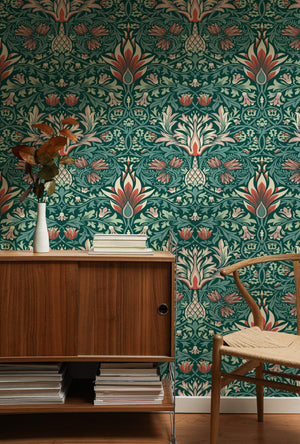
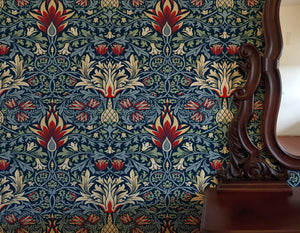
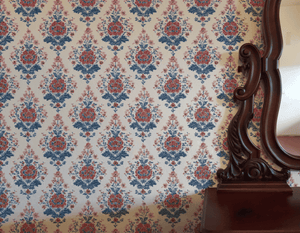
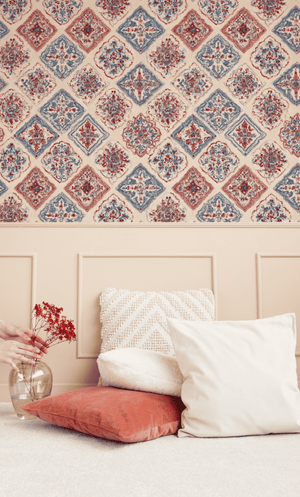
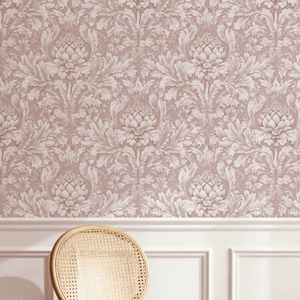
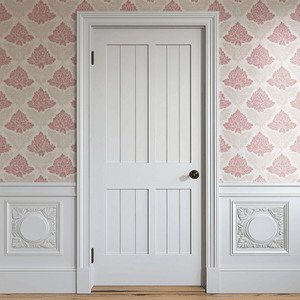
On its own it's a badge. A herald sets one on a coat of arms; a king has it cut into his seal. A smith might top an iron fence with a fleur-de-lis finial, or a woodcarver let one into a panel. Repeat it, though, and the badge turns into pattern, the way wallpaper and fabric carry it (tile and architecture too) across European heraldry and the decorative arts.
Which flower, though? Nobody agrees. Art historians still argue lilium against iris, and a few suspect a deliberate hybrid of the two. We're with the camp that sees a frankly abstract three-petaled bloom copying no single species. English didn't wait for a verdict and called it a lily anyway.
Traditionally it's gold on blue. A herald blazons the old French royal arms azure semé de fleur-de-lys or, "blue scattered with golden lilies," and centuries of that gold-and-blue pairing welded it to French royal identity. Now it comes in every color. Spelling shifts with whoever's holding the pen. Heralds and British writers put fleur-de-lys. We write fleur-de-lis, like most Americans, and older French had fleur de lys.
Where did the fleur-de-lis come from?
Its origin is genuinely uncertain and long argued over. The traditional story belongs to King Clovis of the Franks, who lived around 466 to 511 CE and was the first Christian Frankish king. When he converted, around 496 CE, an angel handed him the emblem (or a baptismal vision did), and from then on it marked the kings of France.
Doubtful, all of it. But the tie to French royalty does reach back to at least the twelfth century, and three-petaled lily forms are far older. They show up in the art of ancient civilizations, from Mesopotamia and Egypt to India.
Louis VII is where the paper trail starts. He reigned from 1137 to 1180 and used the fleur-de-lis on his arms and seals, and from him onward it was firmly the king's sign. Coats of arms and documents picked it up. Architecture took it on as well, and so did the regalia.
Early on the arms used "France ancient," many golden lilies scattered on blue, and that held until Charles V simplified it to "France modern," just three lilies in a triangle, in 1376. It stayed the official French royal symbol until the Revolution of 1789 swept it from public use. The Bourbon restoration of 1814 to 1830 brought it back. Then it lingered (in royalist circles, mostly) long after the monarchy itself was gone.
What does the fleur-de-lis symbolize?
Its symbolism carries several meanings at once, layered up over centuries. The kings came first, or at least loudest. Louis VII put it on his seals, and after nearly six centuries on the royal arms the flower had become shorthand for the divine right of kings.
Priests and painters read it another way. To them it was the Virgin Mary's lily (purity, chastity), with a petal apiece for the Holy Trinity. Looser ideas stuck along the way, perfection among them, light and life too. So when later revivals wanted an emblem with French and European prestige built in, this one was waiting.
What is the religious meaning of the fleur-de-lis?
In Christian art it belongs above all to the Virgin Mary, the lily symbolizes purity, an old emblem of the Virgin, so the flower appears constantly in paintings of the Annunciation and in Marian imagery. Then somebody counted the petals. Three, held as one by the band, was too neat a match for the Holy Trinity to ignore.
Painters weren't the only ones using it. It went onto vestments and into church architecture. Scribes drew it in manuscripts and metalworkers put it on liturgical pieces. The French king, meanwhile, was God's anointed, so the royal lily and the holy one fed each other for centuries (often you can't say which lily you're looking at).


How is the fleur-de-lis used in heraldry?
Heraldry is the native home of the fleur-de-lys, the spelling heralds prefer. The French royal arms made it famous. Plenty of other European coats of arms carry the fleur-de-lys too, as a charge in its own right, and heralds even named a treatment after it: semé-de-lys, a field strewn with small fleur-de-lys (France ancient, more or less).
Countless cities with French or Frankish ties put it on their arms. So did families and institutions, Quebec among them. Look at the tip of a heraldic crown or scepter and you'll often find one perched there as a finial. One rule never bends. In heraldry the fleur-de-lys is always drawn stylized, three petals and a band, never as a naturalistic flower.
How is the fleur-de-lis used in home decor and decorative arts?
It runs widely through traditional, French country, Gothic-revival, and heritage decorating. Nineteenth-century designers leaned on it hard. The Gothic Revival put it nearly everywhere (Pugin laid fleur-de-lis tiles in the House of Commons in 1850), and William Morris and Dante Gabriel Rossetti shared a taste for the medieval that kept heraldic flowers in fashion.
Our pick is the dining room, with wallpaper all over. Gold on deep blue across a 12-foot dining wall gives you the French royal look at full strength, and a room used mostly at night can carry that. Too much ceremony? Make it one element in a larger scheme. In a house that already leans French or classical, it can follow you out to the entry hall or the library. Even the formal living room.
Nor does the motif stay on the walls. Upholsterers and drapery makers use it. Tile makers fire it into ceramic and encaustic tile, and blacksmiths turn it into wrought-iron gates and railings, finials and all. Furniture makers are quieter about it (check the mounts, or the carving).
What does the fleur-de-lis mean in different cultures?
It travels well beyond France. Quebec's came from France, and the provincial flag still flies the fleur-de-lys as a mark of French heritage. Further south, it reached New Orleans with French colonial Louisiana. Now it's the city's civic emblem, and the Saints football team wears it more visibly than anyone.
The Scouts took it around the world as their badge, drawn from the compass point that shows the way (we like that logic). Florence has its own. Several armies put it in their insignia, and countless logos and crests borrow it for a note of tradition and refinement. The petals hardly change from place to place; the meaning does.
Does the fleur-de-lis have a negative meaning?
For some it does, and the history deserves stating plainly. Colonial Louisiana ran under the French Code Noir, and under it enslaved people who tried to escape had the emblem branded onto their bodies. That gives the flower a painful weight in African American history. It's heaviest around New Orleans, the same city that otherwise uses it as a civic symbol.
Many writers now name this directly, and we think they're right to. It doesn't wipe out the heraldic or religious meanings. The hard history sits beside them. On most decorative and heraldic pieces the motif still reads as French heritage and tradition, but leave out the rest and you haven't understood it honestly.
Fleur-de-lis questions
What is fleur-de-lis as a decorative motif?
It is a stylized lily or iris of three petals bound at the base by a horizontal band. Louis VII already had it on his seals in the 1100s, and European heralds and decorators have shared it ever since. Most people still name the French monarchy, though, whose badge it was.
What does fleur-de-lis symbolize?
French royal authority above all, plus the Virgin Mary, the Holy Trinity in its three petals, and ideas of purity, perfection, and light. Add heritage, French and European. That's the one the nineteenth-century revivals were really after.
What does the fleur-de-lis represent spiritually?
In Christian art it represents the Virgin Mary and her purity, with the three petals read as the Holy Trinity bound as one. Start with Annunciation paintings (it's in them constantly), then look around at the church decoration.
Where did the fleur-de-lis come from?
Its origin is uncertain. King Clovis of the Franks has the legend, around 496 CE. Louis VII has the first documents, twelfth century. And the ancient civilizations? They'd drawn three-petaled lily forms long before either man.
Does fleur-de-lis have a negative meaning?
For some, yes. Under the Code Noir in colonial Louisiana, enslaved people who tried to escape were branded with it, and that memory still hurts in African American history, around New Orleans most of all. It hasn't erased the heraldic and religious meanings. They share the flower now.
How is the fleur-de-lis used in home decor?
On wallpaper, upholstery, drapery, tile, wrought iron, and furniture, especially in traditional, French country, and Gothic-revival rooms. We'd run an all-over repeat, gold on deep blue, across a 12-foot dining wall. For something quieter, a single accent device does it.
What are the key design elements of the fleur-de-lis?
Three petals, a tall straight central one and two outward-curving outer ones, tied at the base by a horizontal band, classically in gold on a blue ground. Never naturalistic, either. A herald draws it stylized every time.
In which cultures does the fleur-de-lis hold significance?
France above all, plus Quebec, New Orleans, Florence, and worldwide Scouting, along with many military and civic emblems. The Saints wear it in New Orleans for one reason, a Scout for quite another (that compass point). Same three petals.


