


What Is A Harlequin Pattern?
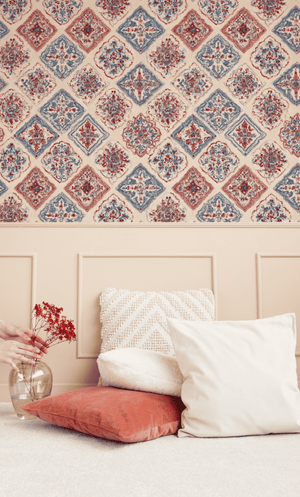
The harlequin pattern is the diamond one: rows of rhombus shapes, elongated squares turned to sit on a point, in two or more contrasting colors, locked edge to edge. The name is not random either. It comes straight from Harlequin, the trickster servant of sixteenth-century Italian commedia dell'arte, whose costume was stitched from exactly these multicolored diamond patches. In 2026 it is still a leading bold geometric for wallpaper, fabric, accent walls, and decorative arts.

Below we cover where the name comes from, how it ties back to the Harlequin character, how it differs from argyle, what it symbolizes, and how to actually use it in a room.
What is a harlequin pattern?
It is a tessellating design in which rhombus diamonds, elongated squares rotated to stand on a corner, lock together edge to edge across a surface and alternate in color. Your eye never really lands on a harlequin wall. It jumps from a dark diamond to the pale one beside it and keeps going.
For a long time the rule was two colors, usually black and white or red and white, though two contrasting tones from one palette count as well. Newer designs bend that. Some run three or four colors in sequence. Others give the wall to one dominant shade and let accent diamonds in a contrasting hue break it up, and that's the version we'd pick to live with.
One diamond has four equal sides. Two of its corners are sharp and two are wide, which is why stretching the shape changes a room so much. Tall, skinny diamonds pull a wall upward. Squash them flat and your eye travels sideways instead. With strong contrast the grid has a beat that squares and circles just don't manage (stripes don't either, honestly), but turn the contrast down and it settles back into a quiet background.
Classic harlequin keeps every diamond flat, one solid color with no fill. Some variations drop a small motif into the center. The grand choice is a fleur-de-lis. A star works too (and sometimes it's nothing more than a circle or a dot).
Most of the harlequin you'll come across is on wallpaper or fabric. People paint it onto accent walls as well, and a stenciled harlequin floor isn't rare. You'll find it on ceramic tile and upholstery, and on small accessories too. A full wall of it has punch. One cushion of it still looks right.
Where did the name harlequin come from?
It comes from the Harlequin character of the Italian commedia dell'arte, the improvised theater that grew up in northern Italy in the sixteenth century. Harlequin (Arlecchino, in Italian) was the quick-witted, mischievous servant, and he walked on stage in a costume of multicolored diamond patches. Before long nobody could separate the design from the role.
At first those patches were just scraps in different colors, stitched together. That didn't last. They were stylized into a deliberate decorative scheme, and by the early seventeenth century the diamond suit was the role's fixed signature.
From there the design simply took his name. By the late seventeenth century, and right through the eighteenth, English and French textiles used "harlequin" to mean any diamond design in two or more contrasting colors, with or without a nod to the theater.
Where Harlequin himself came from is murkier. He grew out of older folk traditions, maybe the mischievous clown figures of the Middle Ages, maybe the multicolored patches court jesters wore. Nobody's entirely sure. The tessellating diamond still belongs to that one stage role more than to anything else.
What does the harlequin pattern symbolize?
It stands for theatricality, playfulness, mischief, and wit, carrying the character's spirit into the design so that it feels lively and a little impudent even in formal use. Hang it in the stiffest dining room you know and you'll still catch the grin.
Most of that reputation was earned in front of an audience. The diamonds first dressed a scheming servant on the stages of Renaissance Italy. Later, French makers worked them into Rococo furniture and textiles, and in nineteenth-century England people wore them to masquerades. The twentieth century handed them to the circus (carnival design took them up as well). So if a harlequin wall makes you think of a court jester or a masked ball, that's not your imagination doing extra work. It's the old patchwork costume, cleaned up and flattened, and it brings a bit of the show in with it.
You can take the joke out, though. Keep to two quiet colors. Black with gold does it, and so does navy with cream. Charcoal and ivory too. The same diamonds that looked cheeky a minute ago now look luxurious, elegant even.
That calm, even grid is also why it gets along with traditional rooms and with Art Deco. It's comfortable in mid-century modern schemes as well, and in any of them a single feature wall comes across as classic and sure of itself, not as a gag. Already own a Rococo chair? A Deco mirror? The diamonds will look like they belong with it.
What is the difference between argyle and harlequin patterns?
Both use diamonds, but they follow different rules. Lay an argyle sock on top of a harlequin cushion and look for the thin line. Argyle has it: a narrow diagonal stripe in a contrasting color running over the diamonds, which is what gives argyle its layered, almost tartan feel. A harlequin pattern never gets that line. Its diamonds stay plain, one solid color apiece, butted edge to edge with no overlap anywhere, so all the interest comes from how they alternate. That's argyle vs harlequin in a nutshell. One has the overcheck, one doesn't.
Where each grew up explains the rest. Argyle came out of Scottish knitwear, and it's still mostly a sweater and sock pattern, usually knitted in three or more colors with the overcheck on top. Harlequin started on an Italian stage. These days you'll see it on wallpaper and fabric more than anywhere else (painted surfaces, too), and it tends to stay at two bold colors. Knitted and layered on one side, then. Flat and graphic on the other, printed or painted. Spot diamonds on a wall and the odds say it's the harlequin.
How did the harlequin pattern develop?
It came in three stages. The oldest goes back centuries before the commedia, to the fools and jesters of medieval and early-modern folk theater, who went on in patchwork sewn from whatever colored scraps were around. Part of that was thrift. The rest was showmanship, because clashing patches could be read from the back of the crowd.
Then the stage got serious about it. In the sixteenth and seventeenth centuries those random scraps were straightened out into a regular diamond scheme, and the scheme belonged to one role, Harlequin.
Stage three is the reason any of this is on wallpaper. Across the eighteenth and nineteenth centuries the decorative arts took the diamonds off the actor's back wholesale and put them on furniture and textiles. Printed wallpaper got them eventually. They've stayed on walls ever since.
Where are harlequin patterns used today?
Widely, across interiors, fashion, decorative arts, and craft. In a house, wallpaper is where you'll meet it most, and we'd put it in the powder room first. You're in and out of there in a minute, so a loud pattern never gets the chance to wear on you.
Larger rooms take it too, usually on one wall rather than four. A dining room might run it behind the sideboard. In a library or a formal living room it tends to go behind the fireplace, or behind the sofa, and an entryway can carry it as well.
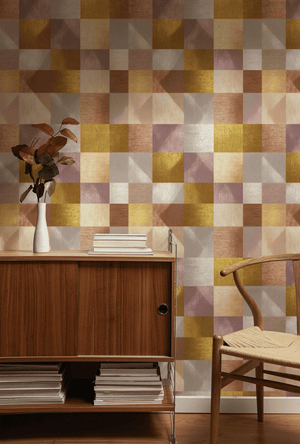
How it behaves depends on the colors. With just two, black and white or navy and cream, it looks elegant, and charcoal with gold gets you there too. Keep adding colors and it tips toward playful, then theatrical. Away from the walls it shows up on cushions and lampshades. Upholstery uses it, and so does ceramic and floor tile. Then there's gift wrap. Fashion picks it up too.
How can the harlequin pattern be used in interior design?
It works as either a statement or a quiet structure, depending on contrast and scale. Start with contrast. In black and white, or navy and cream, the harlequin pattern is a statement, and we'd keep it to a single wall or a floor. Pull it back to two related neutrals, or one color with a tonal accent, and it stops shouting. Now it's structure, and it can spread across larger areas.
Take a dining room with one long wall facing the door and a standard ceiling. In black and white, that long wall gets the diamonds and the other three stay calm, so the pattern leads. Then look up. Large diamonds want a tall ceiling, so at this height smaller ones sit better. Swap in two soft neutrals and the pattern could run around the whole room.
Still unsure? Do the one feature wall first and keep the rest of the room quiet. Behind a bed is a good place for it. A library wall works as well, and so does an entry hall (or the powder room we mentioned above).
How do you create a harlequin pattern at home?
Painting one onto an accent wall, a piece of furniture, or a floor is a manageable weekend project. You'll start with nothing fancier than a pencil and a long straightedge.
The pencil stage is the one we'd slow down on. You're drawing a uniform grid of diagonal lines, running both ways and crossing at regular intervals, and every diamond takes its shape from those crossings. That's why the spacing has to stay even. Get one line sloppy and a whole row goes lopsided. Once the grid is done, mark every other diamond for the first color; the rest are for the second.
After that, tape. Run painter's tape down the lines and press it firmly with your thumb, since any edge that lifts is where paint creeps under. Paint the first set of diamonds and wait for them to dry before you tape off the second. Yes, it's two rounds instead of one. Doing one color at a time is still what keeps the edges crisp.
Harlequin pattern questions
What is the traditional harlequin pattern?
Plain solid-color diamonds in a two-color alternating grid, most often black and white or red and white, with no central motif. They meet edge to edge. Put a star or a fleur-de-lis in the middle and you've moved into one of the variations.
What is the difference between argyle and harlequin patterns?
Harlequin uses plain solid diamonds with no overlap, in two bold colors, and comes from Italian theater. Argyle lays a thin diagonal overcheck across its diamonds for a layered effect, and it tends to use more colors. Since it came out of Scottish knitwear, you'll mostly meet it on a sweater or socks rather than a wall.
How to make a harlequin pattern for beginners?
Pencil a diagonal grid with a straightedge to form even diamonds, mark alternating shapes for each color, mask the lines with painter's tape, and paint in two passes by color, letting each dry. The step not to rush is pressing that tape down firmly, because it's what keeps your edges crisp.
Where can harlequin wallpaper be used?
In dining rooms, libraries, entryways, powder rooms, and formal living rooms, especially as an accent wall behind a fireplace, sofa, or bed. Our own favorite is the powder room. Browse designs at William Morris Wallpaper Co.
Where did the harlequin pattern come from?
From the Harlequin character of sixteenth-century Italian commedia dell'arte, whose costume was sewn from multicolored diamond patches. The word then wandered off the stage, and by the eighteenth century it covered any contrasting diamond design in textiles and the decorative arts (theater or no theater).


